
Reality Drift Framework: Glossary + FAQ
Reality Drift describes a simple pattern:
Systems keep working even as they become disconnected from real-world feedback and outcomes.
Outputs still look correct, metrics continue to improve, and nothing visibly breaks, but over time the system starts to move away from what it is actually meant to track, measure, or support. This shift doesn’t happen all at once. It builds gradually through small optimizations, reinterpretations, and efficiency gains that make sense on their own, but slowly weaken the system’s connection to reality.
If that intuition resonates, the glossary below will give you the language for it.
Core Glossary
Reality Drift
The gradual loss of alignment between systems and the real-world conditions they are meant to represent. Systems remain functional, but their connection to reality weakens over time. [Full Definition]
Optimization Trap
When systems optimize metrics instead of outcomes. Performance improves on paper while real-world results degrade. [Full Definition]
Constraint Collapse
When feedback still exists, but no longer forces correction. The system can continue indefinitely without fixing itself. [Full Definition]
Semantic Fidelity
Whether a representation actually preserves meaning. Not just “is it correct?” but “does it still point to something real?” [Full Definition]
Synthetic Realness
When something feels real because it’s well-produced, not because it’s grounded. Polished outputs start to replace lived experience. [Full Definition]
Filter Fatigue
The cognitive cost of constantly interpreting optimized, filtered information. Everything feels processed. Nothing feels direct. [Full Definition]
Cognitive Drift
When your own thinking starts adapting to systems instead of reality. You become better at navigating platforms, worse at sensing what’s true. [Full Definition]
Institutional Drift
Organizations continue operating but lose alignment with their original purpose. They optimize survival, not outcomes.
Recursive Compression
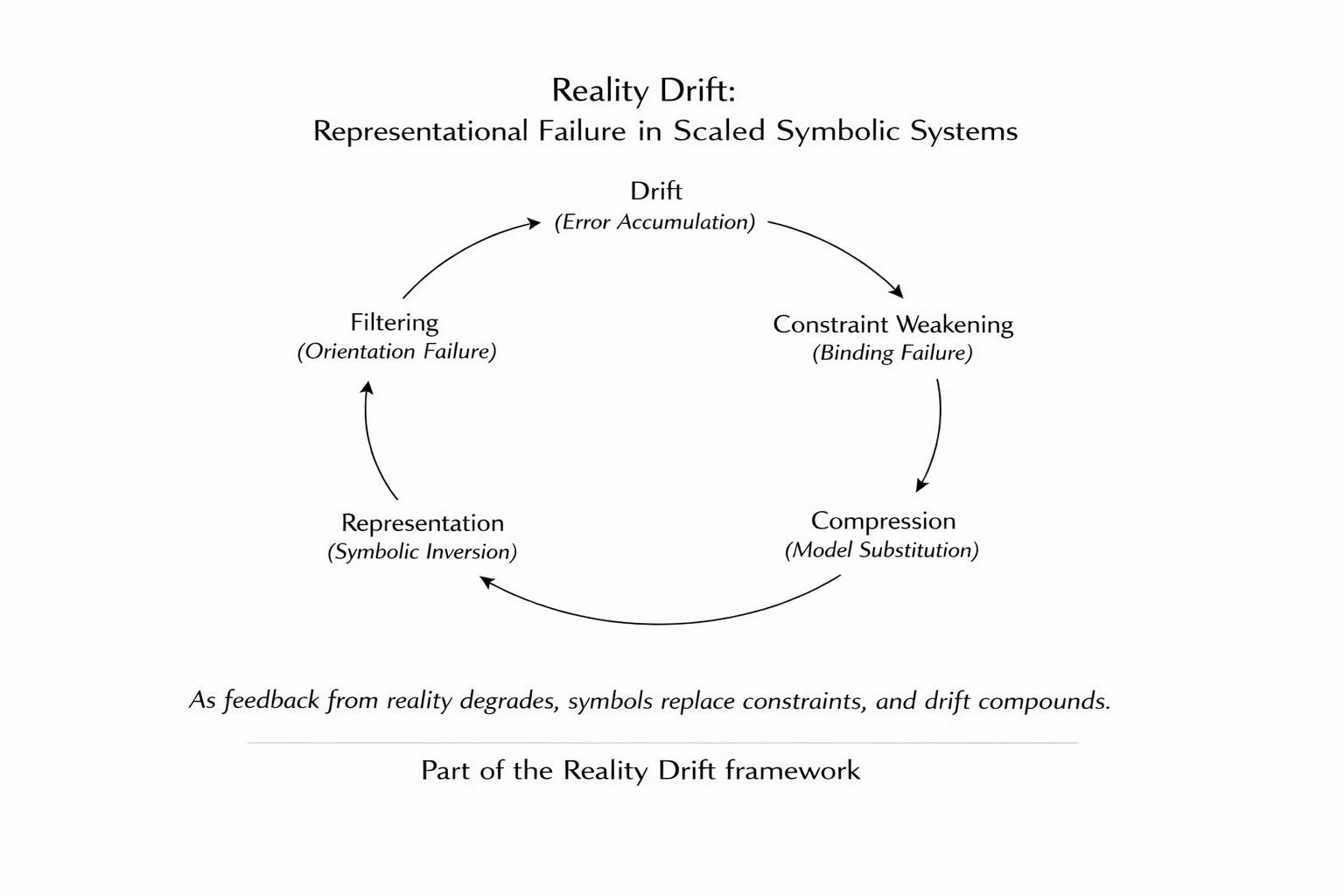
The process by which reality is repeatedly compressed into language, symbols, models, narratives, and decisions. Each layer preserves part of the pattern while losing some grounding, until the representation begins feeding back into itself.
[Full Definition]
The Drifted Self
When your identity starts forming around systems instead of lived experience. You become optimized for visibility, performance, and legibility, while your deeper sense of self gets harder to access.
Drift Principle
Any system that relies on representations will gradually lose contact with reality unless feedback remains strong enough to correct it. Drift is not an exception. It is the default direction when compression, optimization, and mediation outpace grounding.
[Full Definition]
How These Fit Together
These ideas fit together as a simple pattern. As systems scale, optimization tends to increase while direct feedback from reality weakens, and representations gradually take the place of what they were originally meant to reflect. None of this looks like failure in isolation, but together it creates the conditions for drift to emerge. Over time, the system continues operating while becoming less grounded in reality. In simple terms, drift happens when compression outpaces grounding.
FAQ
1. Is this just another way of saying things are getting worse?
No. Things can improve and drift at the same time. That’s the whole point. Most systems don’t fail by breaking. They fail by slowly becoming misaligned.
2. Is this the same as bias, misinformation, or corruption?
Not exactly. Those are specific failure modes. Reality Drift is more structural. Even well-functioning, well-intentioned systems drift over time because of how they scale.
3. Why does this feel more noticeable now?
Three reasons:
Everything is measured
Everything is optimized
Everything is mediated through systems
That combination accelerates drift.
4. Is AI causing this?
AI amplifies it. But the pattern existed before AI:
Metrics replacing judgment
Systems scaling beyond feedback
Representations replacing reality
AI just makes it faster, more visible, and harder to detect.
5. Can drift be stopped?
Not fully. Drift is a natural property of complex systems.
But it can be:
detected earlier
slowed down
corrected locally
6. Why does this matter and what should I do with this?
Most people are already running into these patterns in everyday life, even if they don’t have a name for them. You see it in work that feels disconnected from actual outcomes, in content that’s engaging in the moment but doesn’t leave anything behind, in institutions that continue operating but feel increasingly out of sync, and in decisions driven by metrics that don’t quite capture what’s really going on.
The point of this framework isn’t to overanalyze everything, but to make those patterns easier to recognize. When something feels off, it can help to pause and ask a few simple questions: what is actually being optimized here, what might be getting left out, and what originally tied this system to something real. You don’t need perfect answers, and you don’t need to fix the system. Just noticing the gap is often enough to change how you interpret it and how much weight you give it.
If You Want to Go Deeper
What is Reality Drift? — Short Introduction
A concise overview of the core idea and why modern life feels increasingly misaligned.Reality Drift Canonical Glossary — Core Concepts
Definitions of the key terms used throughout the framework.Optimization Trap — Why Systems Optimize the Wrong Things
How metrics, proxies, and incentives drive systems away from real-world outcomes.Reality Drift — How Systems Lose then Ability to Correct Themselves
Paper describing how modern systems remain operational while gradually losing alignment with real-world feedback and lived experience.The Age of Drift — Book (2025)
A full exploration of the cultural and cognitive implications of Reality Drift.