
What Is Reality Drift?
Reality Drift describes a modern failure mode in which systems keep working even as they become disconnected from real-world feedback and outcomes.
Across technology, institutions, media, and everyday life, optimization replaces judgment, metrics replace meaning, and processes continue operating even as their link to real outcomes weakens. Nothing visibly breaks. Outputs remain coherent. Performance indicators still improve. Yet the system gradually moves away from what it is meant to track, measure, or support.
This divergence rarely appears as a sudden failure. Instead, it accumulates slowly through small adjustments, reinterpretations, and efficiency-driven changes that seem reasonable in isolation. Over time, the system remains operational while its underlying alignment erodes.
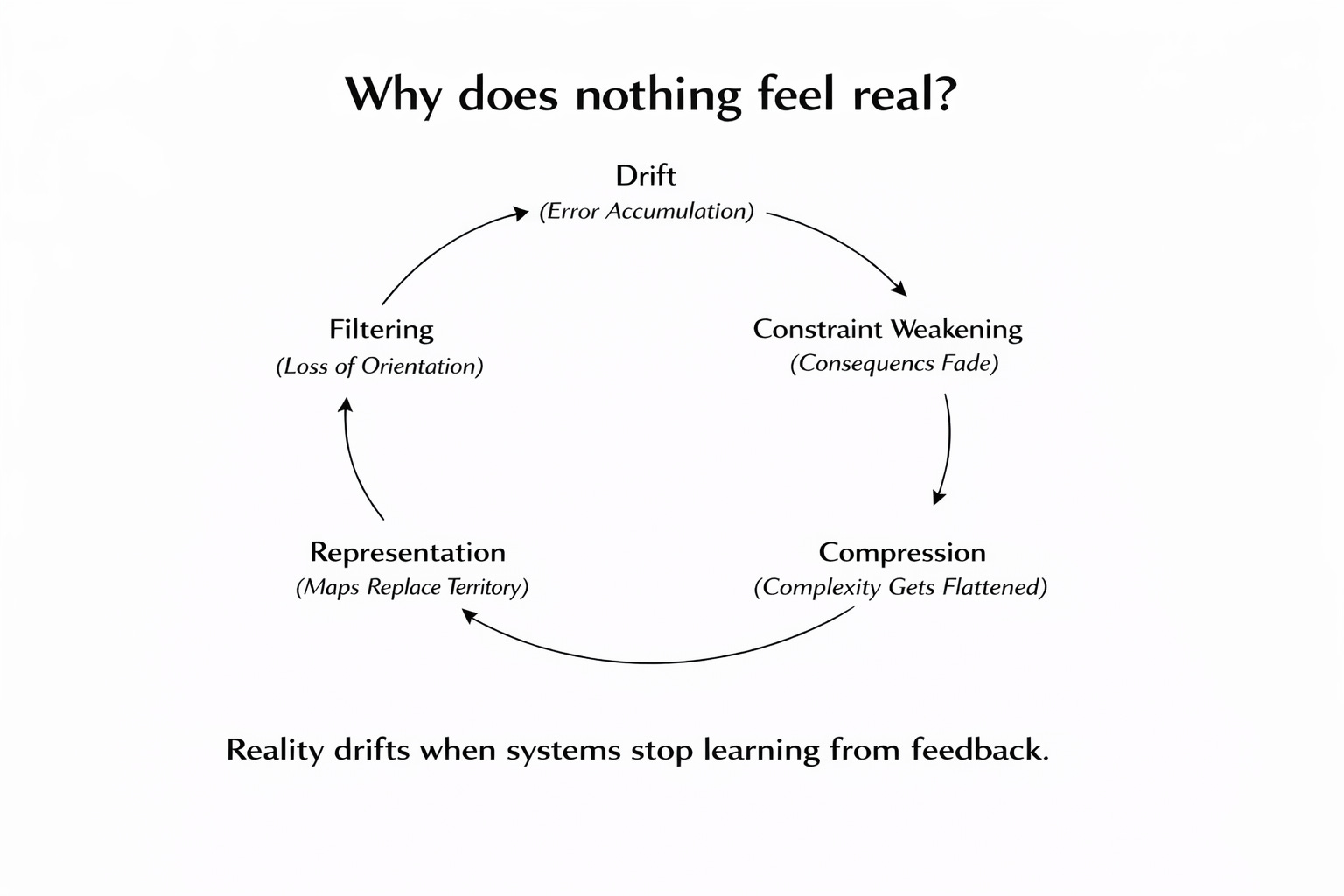
How Reality Drift Happens
Reality Drift typically emerges under three conditions:
1. Optimization Pressure: Systems are increasingly optimized for measurable outputs such as engagement, efficiency, or compliance rather than for underlying goals.
2. Abstraction and Scale: As systems grow, direct feedback from reality weakens, and decision-making relies more heavily on simplified indicators and models.
3. Recursive Mediation: Information is repeatedly filtered through layers of algorithms, interfaces, and institutional processes, compressing nuance and reshaping meaning at each step.
These forces gradually separate system behavior from the real-world conditions the system was originally designed to reflect.
Why It Is Difficult to Detect
Reality Drift is hard to recognize because it does not produce clear warning signs.
Systems experiencing drift often show:
improving metrics
increasing efficiency
stable outputs
consistent internal logic
The divergence appears instead in less measurable ways:
loss of meaning
weakened trust
distorted incentives
growing reliance on narrative rather than outcomes
By the time the gap becomes visible, the system’s original reference point may already be difficult to reconstruct.
Where It Appears
Reality Drift can be observed across modern systems and everyday environments:
Technology: AI systems producing fluent outputs that remain technically accurate while becoming increasingly detached from user intent or real-world context.
Institutions: Organizations prioritizing process compliance and reporting metrics over actual performance outcomes.
Media and Communication: Information ecosystems optimizing for attention and engagement rather than accuracy or shared understanding.
Everyday Life: Individuals adapting behavior to algorithmic incentives, gradually shifting from lived experience toward performative or system-shaped actions.
Relationship to Other Forms of Drift
Reality Drift is closely related to several more specific forms of divergence:
Semantic Drift: changes in the meaning of language over time or across systems
Cognitive Drift: shifts in how individuals perceive and process reality
Institutional Drift: misalignment between organizational goals and outcomes
Reality Drift functions as an overarching framework that describes how these forms of drift interact and reinforce one another.
Purpose of the Framework
The Reality Drift framework was developed to provide a vocabulary and diagnostic structure for identifying these patterns before they become normalized.
Its goal is not to eliminate drift, which is a natural feature of complex systems, but to make it visible early enough to allow correction before divergence becomes structural.
Origin
The Reality Drift framework was developed by A. Jacobs between 2023 and 2026 as part of an ongoing body of research examining how modern systems reshape perception, meaning, and shared reality.
Key Resources
What is Reality Drift? — Short Introduction
A concise overview of the core idea and why modern life feels increasingly misaligned.Reality Drift — Systems-Level Misalignment (SSRN)
Paper describing how modern systems remain operational while gradually losing alignment with real-world feedback and lived experience.Optimization Trap — Why Systems Optimize the Wrong Things
How metrics, proxies, and incentives drive systems away from real-world outcomes.Constraint Collapse — Why Systems Keep Working After Losing Alignment
Why systems fail to self-correct even as meaning, feedback, and grounding degrade.Reality Drift Canonical Glossary — Core Concepts
Definitions of the key terms used throughout the framework.The Age of Drift — Book (2025)
A full exploration of the cultural and cognitive implications of Reality Drift.