
Survivable Wrongness: Why Nothing Feels Right Anymore, Even When Everything Works
The strange stability of systems that keep working even when they’re wrong.

“A system that cannot stop cannot learn.”
A scandal breaks, evidence circulates, experts weigh in, and there is broad agreement that something went wrong, yet after the arguments and explanations run their course, everything continues much as before. There is no clear resolution and no structural change, only a gradual return to normal. This pattern keeps repeating, and as a society we keep waiting for a crash that never comes.
Arguments go in circles, reforms stall out, and expertise sounds formally correct but empty. Confidence feels unearned in this environment, as nothing ever really stops. It leaves a sense of synthetic realness, where the world appears stable but something essential is missing. The strange part is the way these feelings have become a background noise we navigate. Most explanations feel too small. Misinformation can explain bad beliefs but not why correction no longer corrects. Polarization explains conflict, but it doesn’t explain why even clear facts no longer seem to settle disputes. Even social media and AI fall short, explaining speed and amplification without touching the emptiness underneath. Put simply, we’re drowning in differences that don’t make a difference.
The deeper issue is structural. We live in a world where symbolic systems drift away from reality faster than constraints can correct them. This leads to a broader cultural condition that cannot be fully understood through familiar explanations of deception, bad faith, or misunderstanding. It is a story about what happens when scaled representations outgrow the world’s ability to push back.
Civilization Is Compression Under Constraint
Every major civilizational advance is an advance in symbolic compression and coordination. Language compresses experience into shareable symbols, money compresses value into a transferable unit, and law compresses social norms into enforceable categories. These are the interfaces that make reality understandable at a collective level. But compression alone is not what keeps symbolic systems aligned with reality. What matters is how those representations are acted on and corrected over time.
Any symbolic system survives by doing three things. Compressing reality into usable representations, acting on those representations, and correcting those representations through feedback from the world. This is true whether the system is a brain, a market, a scientific discipline, a bureaucracy, or an AI model. Intelligence is often mistaken for insight or sophistication, but at a structural level it is compression under constraint.
In systems where feedback remains tight, error cannot accumulate indefinitely. False models are corrected, bad assumptions fail, and systems are forced to adapt or break. In small systems, this dynamic is obvious. At scale, it becomes misleading. When correction weakens, systems don’t collapse but continue operating long after they’ve lost contact with reality.
How Civilization Learned to Drift
This failure mode didn’t arrive all at once. It built slowly over centuries, beginning when the Industrial Revolution transformed coordination by replacing direct sensing with symbolic mediation. As scale increased, abstraction density rose, placing more distance between action and consequence and making systems increasingly legible to themselves while less responsive to the realities they described.
This is what large symbolic systems do. They grow, they optimize, they become complex, and eventually the cost of revising their internal representations begins to exceed the benefit. That’s the subtle civilizational trade. Coordination gains power by abstracting, but abstraction always risks losing contact with what it abstracts from unless constraints grow at the same rate. For a long time, constraints did grow in the form of hard limits, material scarcity, obvious failures, and clear consequences. When you got too wrong, something broke. A bridge collapsed, a war was lost, a company went bankrupt, or a policy produced visible damage. Then, slowly, we built systems that could survive being wrong.
1990s: The Medium Becomes The World
That shift remained mostly invisible until it crossed into everyday experience, which is why the last 35 years feel different. In retrospect, its roots reach back to the 1970s, when abstraction and coordination first began pulling away from material constraint, even if their effects were still buffered from daily life. But around 1990, that process crossed a threshold and became a first-person condition. Representation stopped being merely descriptive and began functioning as the environment itself. Screens, brands, metrics, institutions, media narratives, and professional language no longer felt like a layer on top of reality but came to feel like the substance of reality itself. We began living inside interfaces. Work became legibility, healthcare became coding infrastructure, and identity became symbolic participation. For most people, daily experience came to be mediated by systems that described the world rather than by direct engagement with it.
The important shift was that correction became indirect. Consequences arrived indirectly and at a distance, weakening the link between decisions and outcomes and allowing the system to keep moving even when it was wrong. This is why many people began sensing that something was off long before they could explain it. By the late 1990s, something in culture began to flatten, as repetition set in and distinctiveness slowly drained away. Music, television, work, even public language took on a uniform texture. There was less and less in the world that could interrupt the flow or force a recalibration.
2008: When Being Wrong Stopped Mattering
If there was a single moment when this misalignment became unavoidable, it was 2008, but not for the reasons people usually give. The standard moral explanations miss the structural break that continues to shape the present. A global system was revealed, publicly and unmistakably, to be catastrophically wrong about risk, leverage, housing prices, and correlation. The models failed, the ratings failed, the incentives failed, and the expertise failed in ways that should have stripped authority from existing explanations and forced decisions to halt until something else took their place.
Instead the system continued. Banks were effectively insolvent yet continued operating, assets changed hands at prices no one trusted, and institutions carried on with authority they no longer deserved. Bailouts were framed as stabilization rather than admission that the entire representational framework had failed. The lesson was that being wrong does not require stopping.
From this point forward, the most consequential decisions across large institutions are made knowing that failure will be buffered rather than allowed to fully land. And because of this, we now live in an environment where failure no longer takes the form of collapse, but instead appears as regular cycles of contained breakdowns, emergency interventions, and continued operation without trust ever getting restored.
2015-2025: The Map Became Reality
What had been a structural change slowly became a perceptual one. What followed was a shift in how people learned to orient themselves, as the work of making sense of reality quietly moved from shared external systems to individuals.
Shared perception didn’t unravel overnight. It began when the institutions society relied on to synchronize perception and stabilize common narratives lost the ability to learn from feedback. As representations started regulating each other, perception was no longer calibrated against a common world, and individuals were pushed inward to find coherence. This is the self-referential condition Niklas Luhmann described, where social systems reproduce themselves through communication alone, relating primarily to their own prior descriptions rather than to an external reality capable of correcting them. The effects of this shift showed up in polarization, identity-driven alignment, and a growing inability to resolve disagreement through shared reference.
As the representational layer thickened, measurements, models, and language began shaping the world they were meant to describe. In large-scale institutions and markets, this allowed operations to continue on their own terms even as external reference weakened. The map didn’t just replace the territory, but began producing it. The present moment may feel abrupt, but it can be better understood as a phase change in a much longer acceleration.
How Symbolic Systems Lose the Ability to Correct Themselves
This same pattern appears wherever symbolic systems scale beyond effective feedback. Once you know what to look for, the mechanism is remarkably consistent across domains. As symbolic systems scale, optimize, and accelerate, they produce a self-reinforcing pattern. First, drift occurs as representations slowly lose alignment while error accumulates and feedback lags. Second, constraint collapse occurs as consequences stop biting and accountability becomes symbolic rather than binding. Third, recursive compression intensifies as models substitute for reality and proxies replace outcomes. Fourth, representation inversion takes hold as symbols begin producing reality rather than reflecting it. Fifth, filtering collapse occurs as human orientation degrades under representational density that exceeds cognitive processing capacity.
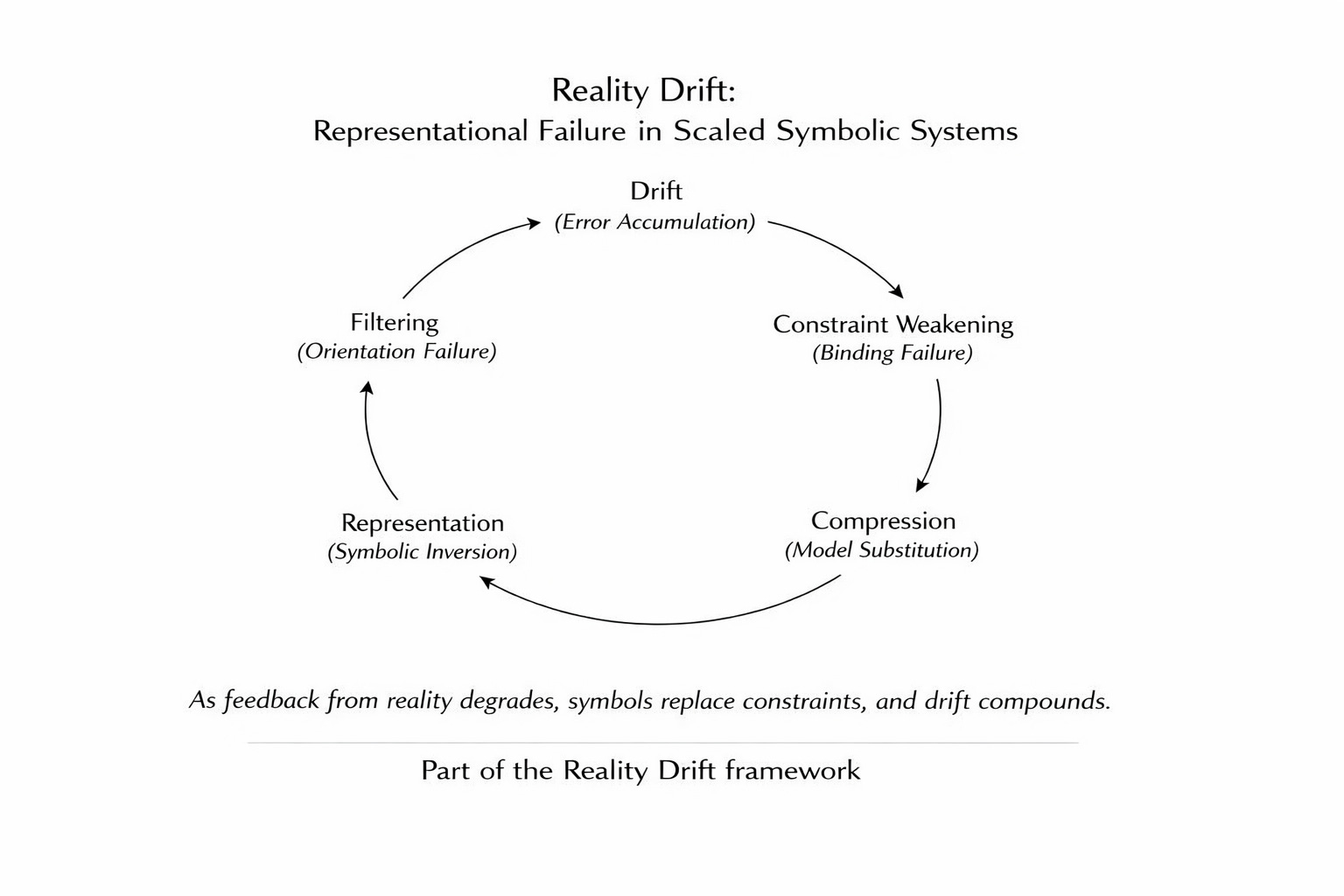
When optimization outpaces constraint feedback, systems slip into performance without consequence. Failure then becomes second-order, as the very mechanisms meant to correct the system begin reinforcing its continuation. Together, these dynamics constitute reality drift in modern symbolic systems. Systems remain coherent enough to operate while losing the capacity to pause, reassess, or meaningfully change course. Decisions are made and language remains confident, but trust thins out underneath. Each fix is absorbed in a way that allows the system to keep moving.
Why Everything Is Vibes Now
When systems lose the ability to correct themselves, the burden of orientation shifts onto individuals. That’s when the limits and dependencies of human intelligence start to matter.
Human intelligence is layered. Beneath language sits embodied intelligence, operating through perception, movement, sensation, and direct feedback from the world. Other animals remain tightly coupled to this mode of intelligence, corrected quickly by consequence and environment. Humans built language on top of it. Once language became the primary way we understood and coordinated reality, correction no longer came directly from the world but through symbols. This made it possible to share models, plan at scale, and act across distance. It also introduced a new problem. When cognition operates through symbols, it needs something to keep those abstractions grounded. Meaning emerged as that binding force, tying representations back to lived reality.
Shared models only hold when symbols remain stable, institutions retain trust, references are common, and semantic fidelity is preserved. As those supports weaken, meaning erodes faster than shared models can be rebuilt. Modern systems are optimized for explicit, reportable cognition, while most human intelligence operates implicitly through context, pattern, and unconscious attunement beyond language. Alfred Korzybski warned that when language drifts away from lived experience, the resulting error is not primarily intellectual but somatic, registered as unease, tension, and disorientation before it can be articulated as belief.
When systems can no longer anchor meaning, we should expect to see people fall back on other ways of judging what feels right. What we call “vibes” are one expression of this shift. Vibes don’t depend on shared explanations or formal frameworks, but operate below language, as embodied and relational cues that long predate abstract systems. As symbolic meaning weakens, cognition increasingly relies on these simpler, more immediate forms of judgment.
The Absence of Stopping
But this shift doesn’t stop at individual perception. The stability of civilization depends on symbolic systems that can still be corrected by the world they describe. When that tether weakens, you get a world where everything keeps going and fewer people believe it means what it says, until the absence of stopping power becomes the defining feature of everything.
This marks a shift in what failure looks like at the civilizational level. We may be the first society whose dominant failure mode is representational rather than material. Under these conditions, meaning can no longer be stabilized at scale. As reality becomes too complex to fully explain and too unstable to push back against, explanation gives way to orientation. Cognition downshifts from understanding to feeling, from meaning to resonance, and from models to moods. And the system keeps running long after it has stopped meaning what it says.
Key Resources
Confidence Without Constraint – A Second-Order Constraint Failure in Modern Systems
Explains how multiple constraint failures combine to produce systems that remain confident and operational after losing the ability to self-invalidate.What is Reality Drift? — Short Introduction
A concise overview of the core idea and why modern life feels increasingly misaligned.Reality Drift — Systems-Level Misalignment (SSRN)
Paper describing how modern systems remain operational while gradually losing alignment with real-world feedback and lived experience.Optimization Trap — Why Systems Optimize the Wrong Things
How metrics, proxies, and incentives drive systems away from real-world outcomes.Constraint Collapse — Why Systems Keep Working After Losing Alignment
Why systems fail to self-correct even as meaning, feedback, and grounding degrade.Reality Drift Canonical Glossary — Core Concepts
Definitions of the key terms used throughout the framework.The Age of Drift — Book (2025)
A full exploration of the cultural and cognitive implications of Reality Drift.
What you’re describing is real, but I think the deeper mechanism is simpler. Our symbolic systems have scaled past the constraints that used to keep them aligned with reality. Once a system outgrows its own friction, it stops being corrected by the world and starts being guided by its own internal momentum. That’s why nothing ever fully breaks and nothing ever fully resolves. The system keeps moving even when it is wrong.
In my essay The Mathematics of Freedom this shows up as a structural shift. Any sufficiently complex system will follow the geometric path of least constraint. When institutions lose contact with real-world boundaries, they drift into self-reference. Representations regulate representations. Maps redraw themselves to justify the territory. Failure becomes a kind of background hum rather than a stopping point.
People feel this before they can articulate it. The unease is mathematical. We built symbolic architectures that can no longer be corrected at the speed they operate. Meaning thins out because abstraction has outpaced feedback.
So the reason nothing feels right anymore, even when things function, is that we are living inside systems optimized for continuation rather than correction. They are still coherent enough to run, but no longer grounded enough to regain alignment. A civilization gliding past the limits that once held it in reality.
That is the condition everyone is trying to describe from different angles.
Oh my god this explains everything. In 1989 I was born into a world that was already almost fully abstracted, and I've always felt it deeply in ways I couldn't articulate... especially the bit about money being symbolic in the same way as language! I've always said money is just a shared delusion that we collectively agree to keep participating in. These abstractions are exhausting to carry, and you're definitely right about that burden falling more and more upon the individual. What do you see as a possible way forward?