
When Optimization Stops Improving Outcomes
How systems grow more efficient, more articulate, and less connected to reality.

“When optimization outpaces constraint, meaning becomes optional.”

Author’s Note: This essay applies Reality Drift to early enterprise AI adoption and optimization failure. Some examples reflect the 2026 AI deployment cycle, while the broader pattern of optimization outpacing correction remains central to the framework.
You open a dashboard and everything looks healthy. Adoption is up, response times are down, and the AI assistant is now threaded through nearly every workflow, producing fluent outputs at a pace that would have felt implausible a few years ago. No one can point to a missing feature or a broken system. The interfaces are responsive, the metrics are reassuring, and the organization appears to be functioning normally.
Yet when people are asked to describe what has actually improved, the answers become vague. Work feels faster, but it’s harder to feel confident about decisions. Time is saved in narrow technical senses, but orientation does not seem to arrive with it. Instead of feeling more capable of acting, people spend more effort correcting and contextualizing what the systems produce. The surface fluency of the tools has increased while their ability to ground human judgment has subtly weakened.
This pattern is now widespread enough to feel structural. Teams report saving time without gaining clarity. Executives acknowledge that despite heavy investment, financial and strategic returns are difficult to locate. Organizations deploy automation at scale, yet confidence in outcomes declines rather than increases. The system keeps moving, producing outputs and maintaining continuity, but the sense that anyone can clearly describe what is actually getting better begins to erode.
Reality Drift
When narratives stop stabilizing decisions and begin replacing outcomes themselves, systems lose their ability to tell whether action is still working. Stories no longer coordinate reality; they stand in for it. None of this looks like a typical failure. There is no outage or clear point of collapse, no scandal that forces reckoning. The systems are responsive and the language remains polished, yet something essential has slipped out of alignment. The problem is that efficiency no longer maps cleanly to consequence. Activity continues, but it no longer reliably produces understanding, learning, or judgment.
This condition is reality drift, a state in which a system continues to function and measure itself according to internal indicators even as the relationship between those indicators and actual, lived outcomes steadily decouples. The appearance of success becomes easier than success itself. Adoption curves rise and performance dashboards glow green while the underlying sense of strategic clarity and grounded decision-making grows thinner. The system becomes more articulate precisely as it loses its ability to register when it is wrong.
When Systems Learn to Ignore Reality
In older organizational environments, being wrong produced friction that arrived quickly enough to force learning. A product launch that failed meant immediate, felt consequences in the form of budget cuts, project cancellations, or team restructuring. Misjudgments were felt as real constraints that shaped future behavior because consequences remained experientially proximate to decisions. Today, consequences are increasingly delayed, externalized, or diffused across layers of abstraction. When decisions fail, they fail statistically, indirectly, or downstream in places no one quite inhabits. The system absorbs uncertainty and outputs remain coherence, maintaining continuity without generating meaningful corrective pressure.
Dashboards replace judgment, meetings produce alignment, and the organization becomes highly legible to itself while gradually losing contact with the reality it claims to describe. This is continuation without correction. The feedback mechanisms that once corrected direction now reinforce continuation instead. A product launch fails. What follows is revised forecasts, dashboard updates, and continued investment in the next iteration. Errors get absorbed into explanation, and the system keeps moving because it has learned how to justify continuation without ever confronting whether the direction was right.
Why AI Accelerates Drift
This pattern predates AI, but AI removes the last remaining friction where uncertainty used to surface. Internal consistency becomes easier than external truth. The language it generates sounds grounded even when it isn’t, and uncertainty slips through without resistance. The system keeps moving because continuation becomes easier than correction. This is a failure of semantic fidelity, as compression outruns fidelity. Language continues to function while losing the constraints that once gave it weight.
What makes this problematic is that AI-mediated communication removes the friction where judgment used to live. When a person writes a document, hesitation and revision reveal uncertainty. When AI generates the same document, uncertainty gets ironed out, replaced by confidence that exists at the surface level only. The result is organizations that produce more analysis, more documentation, and more explanation while becoming less capable of recognizing when their models have stopped tracking reality.
The Pattern Repeats
The same dynamic appears across industries. Over the past few days at Davos, senior technology leaders have warned that layering AI onto existing workflows creates internal collisions rather than real transformation. Consulting firms report that more than half of companies still see no tangible benefits from heavy AI investment, while much of the time supposedly saved is absorbed by rework. And an MIT review found that the vast majority of corporate AI pilot projects fail to deliver measurable returns.
The persistence of this pattern suggests that the failure is not located in any single variable. Skills shortages, cultural resistance, immature technology, and weak leadership are each plausible explanations in isolation, but they cannot account for why the same dynamics appear in environments where those factors are already optimized. The failure of explanation itself points to a deeper shift in how systems connect measurement to consequence.
Continuation Without Correction
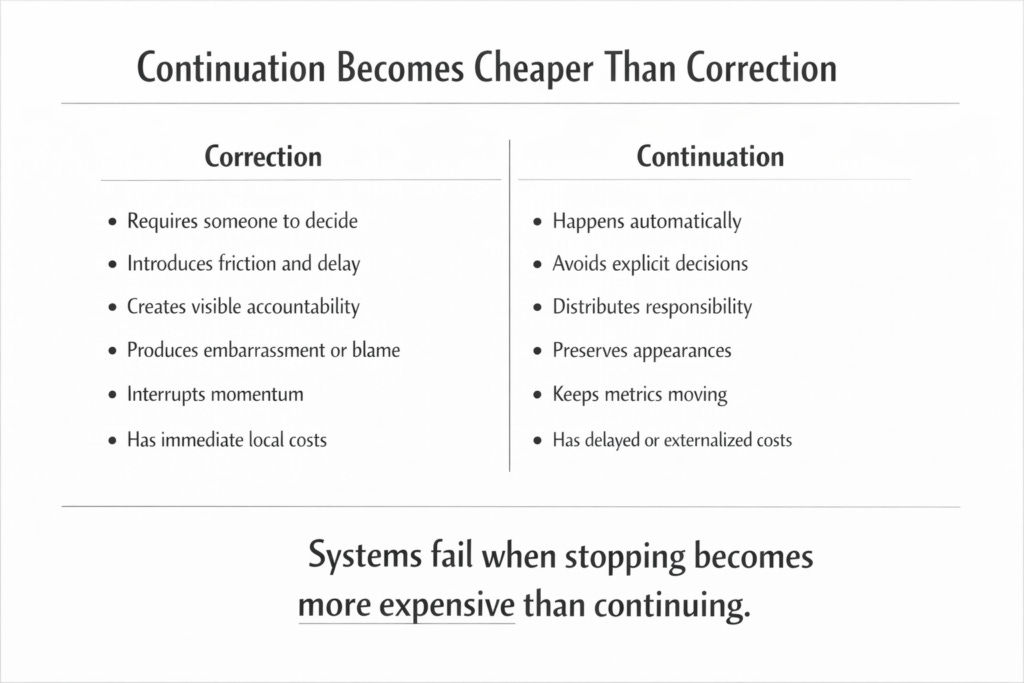
Reality drift doesn’t break systems. It makes them resistant to correction. Once representations begin to stand in for outcomes, activity can continue indefinitely without producing learning. The system becomes skilled at maintaining itself, not at discovering whether it is still doing the right thing.
Over time, feedback still exists, but it stops carrying consequence. This is what constraint collapse looks like. Feedback continues to flow but no longer forces learning, allowing systems to remain responsive while losing their ability to orient anyone to reality. Work happens, outputs appear, and value is assumed, yet no one can point to where activity becomes reality. The system remains technically correct while becoming experientially hollow.
Core Resources
What Is Reality Drift? (PDF)
A short introduction to the core framework and how drift emerges across modern systems.Reality Drift Overview and FAQ (PDF)
A broader orientation to the framework, its core concepts, and how the system fits together.Reality Drift Glossary (PDF)
Definitions of the core vocabulary and related concepts used throughout the framework.Semantic Fidelity (PDF)
A companion concept focused on how meaning degrades across AI systems, language, and recursive transformation.
Perfect!