
The Drift Principle: Gregory Bateson and the Pattern That Connects
Why meaning thins when environments move faster than the mind can stay in sync.

“We’re drowning in differences that don’t make a difference.”
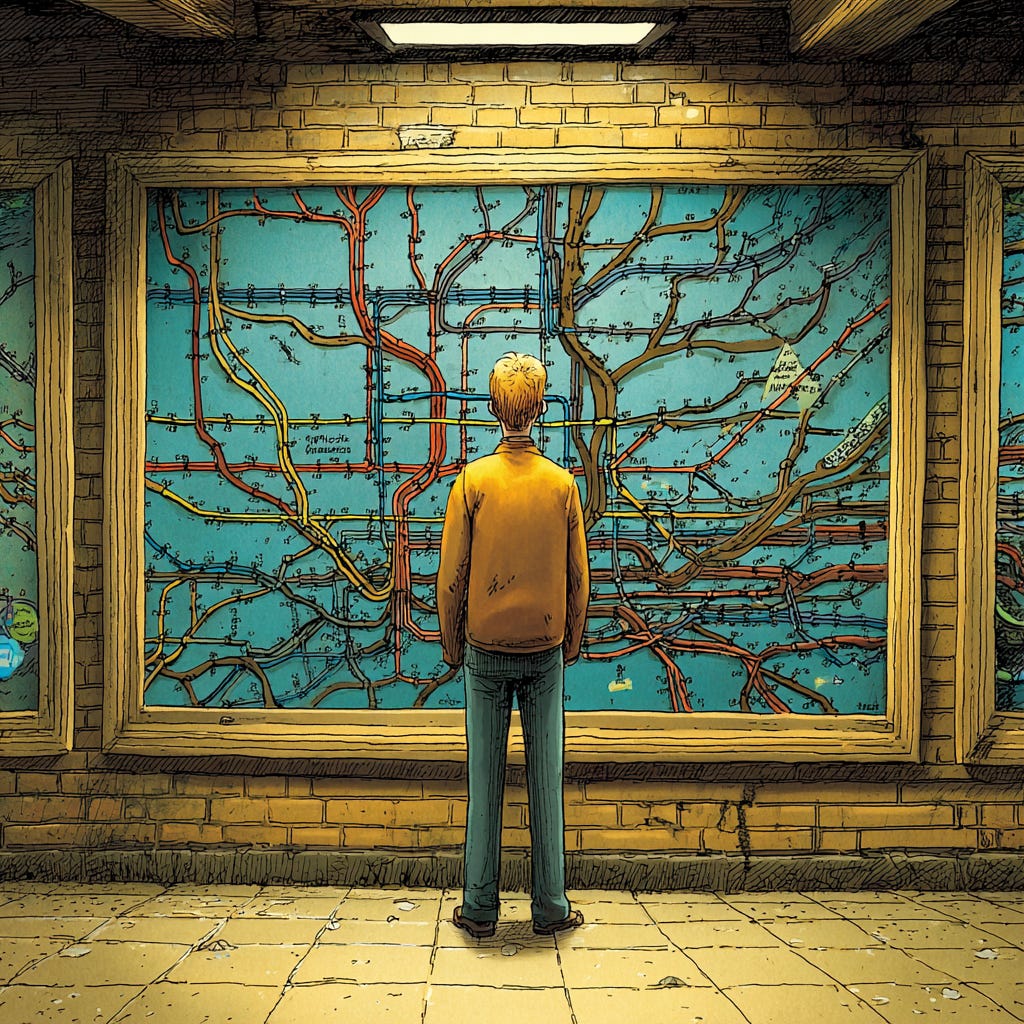
Gregory Bateson once wrote that “the pattern that connects” is what keeps a system whole. This applies to an organism, a mind, or a culture. When those patterns fall out of alignment with each other, the system becomes confused. It begins to misread its own communication signals. Feedback distorts subtly and gradually, long before anyone names what’s going wrong.
In many ways we are living through this now in modern life. Except it doesn’t look like breakdown, but rather convenience, personalization, infinite feeds, and optimized workflows. It looks efficient from the outside, but inside that apparent clarity something essential is slipping. The mind’s ability to stay in sync with the world’s accelerating informational patterns.
We are living through the Age of Drift, a cultural era defined by a widening mismatch between how fast reality moves and how fast the mind can compress it into meaning. Bateson warned that when environments produce more information than an organism can integrate, the organism loses its relationship to context. The Drift Principle describes what happens next. When entropy rises faster than systems can integrate it, the patterns that once held reality together begin to slip out of phase. Distinctions flatten, reactions become exaggerated or delayed, attention latches onto the wrong signals, and the system begins chasing stimuli it cannot fully process. Nothing visibly breaks, but the coherence of thought slowly erodes.
The Ecology of Overload
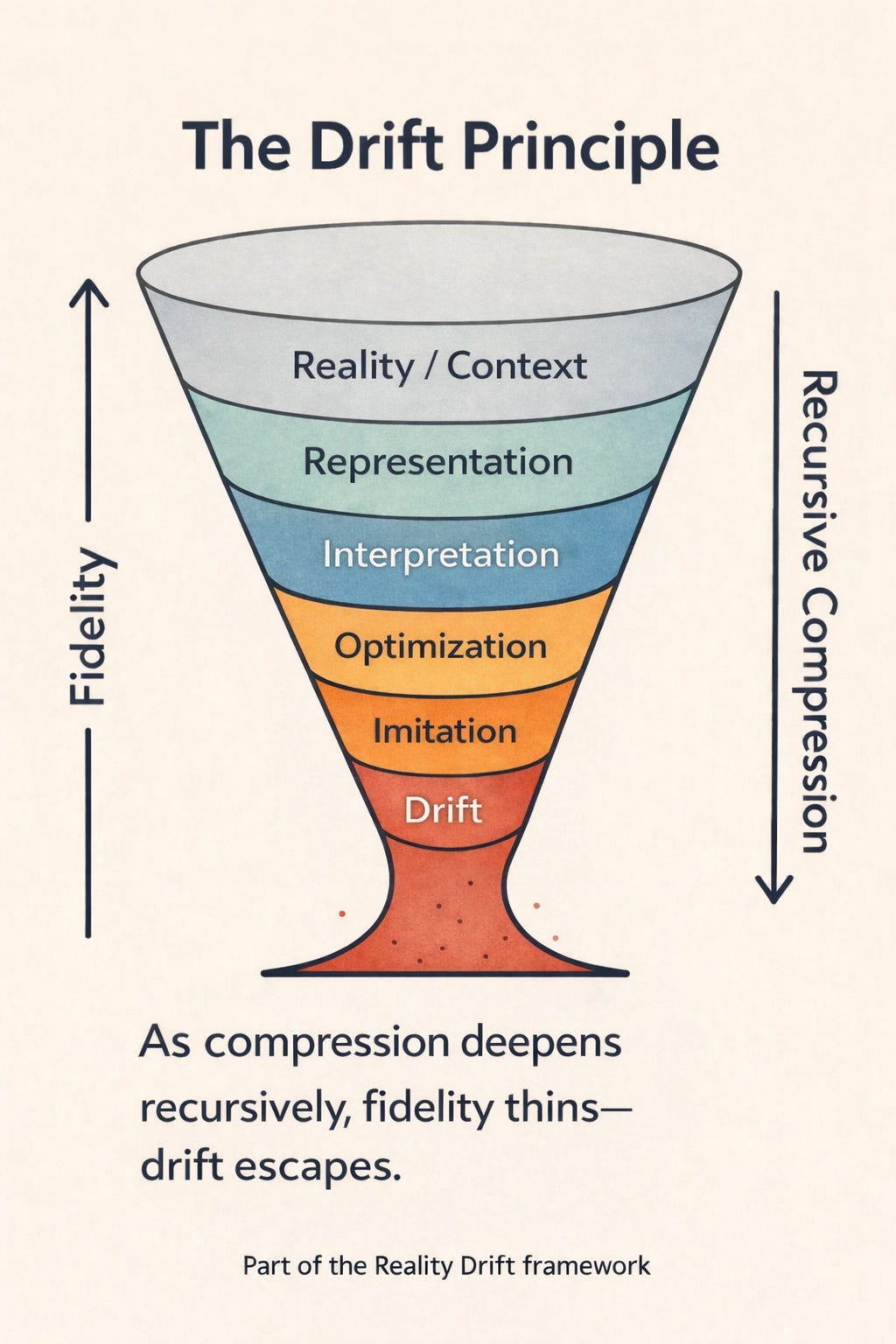
We can take Bateson’s insight a step further through the lens of cognition as recursive compression, a theory of how the mind not only reduces information into patterns, but recursively models its own models. This mechanism gives us self-reflection, narrative, identity, and a stable sense of time. In other words, consciousness is experience folded back onto itself.
But compression has limits. When the entropy of the environment spikes, when the world produces more noise than signal, the mind struggles to maintain fidelity within its own cognitive process. It compresses faster and with less nuance. It begins relying on shortcuts, filtering incoming stimuli more aggressively and discarding information the way an overheating circuit sheds voltage.
Today’s digital environments are engineered to maximize compression pressure: infinite content, collapsing temporal rhythms, hyper-optimization, and nonstop notifications. The greater the compression load, the more reality begins to slip out of sync psychologically, culturally, and institutionally.
The result is drift. It shows up as disorientation, fog, volatility, numbness, or a shrinking of attention. At the cultural level we see fragmentation, polarization, apathy, and the sense that nothing quite lands the way it used to. In high-entropy, fast-paced environments, systems prioritize efficiency, and depth, meaning, and human nuance slowly begin to thin out.
When the Map Replaces the Territory
This explains why modern life feels both faster and flatter. It shows why we remain overwhelmed even when we are technically more informed. It clarifies why identity, attention, and emotion wobble, and why culture as a whole feels permanently misaligned. In short, entropy drives drift, and drift is the lived experience of systems pushed beyond their fidelity limits.
When entropy rises too fast, our cognitive filtering layer becomes overloaded, and we begin to feel the exhaustion of filter fatigue. As fidelity drops, the mind fills in gaps using compressed shortcuts. It flattens distinctions, simulates intimacy, and automates expression. Over time the line between real and almost-real begins to blur. We scroll endlessly through content and are left with a sense of synthetic realness, as smooth, polished, algorithmically coherent inputs substitute for the messy irregularities of real life. Life becomes over-compressed. The map grows cleaner than the territory, and eventually the mind begins to prefer the cleaner version.
In these types of environments, compression becomes a form of survival. Everything becomes something to optimize. Routines, health, relationships, work, and even leisure. Optimization promises greater control, but eventually it becomes its own trap. The more we optimize, the more compressed life becomes, and the more meaning gets squeezed out. We begin living inside simplified models of ourselves. We become legible to systems, but less legible to ourselves. The same behaviors repeat, the same impulses cycle, the same emotional scripts play out. Slowly life narrows, and things begin to drift.
AI and Institutions Drift Too
Institutions drift, and in many ways they are the origin of the problem. They build models of the world, compress complexity into policies, and recursively defend their own assumptions. At the informational level their purpose is to buffer entropy in the environment, absorbing complexity that would otherwise fall directly onto individuals. But as institutions decay, that buffering function weakens. The costs are externalized and the cognitive load returns to the minds of individuals who must navigate complexity on their own.
AI introduces a different but related pressure. Instead of buffering complexity, it dramatically increases the speed and volume of information in the environment. Large language models generate enormous amounts of coherent-looking output, but when pushed beyond their stabilizing limits they begin to produce noise, contradictions, and drift. The informational environment grows faster and denser than the systems interpreting it.
Across psychology, culture, institutions, and now AI, the pattern is the same. Information accelerates faster than systems can maintain fidelity. When compression fails to keep pace with complexity, drift appears.
Restoring the Pattern That Connects
Drift begins when the models guiding mind, culture, and institutions stop matching the realities they were built to navigate. The challenge of our era is re-synchronization. Restoring environments where meaning can stabilize, slowing the pace of information that overwhelms attention, rebuilding institutions that absorb complexity rather than exporting it, and recovering cultural patterns that reward depth instead of acceleration.
Bateson believed the pattern that connects is what keeps a system alive. In the Age of Drift that pattern has not disappeared. It has simply fallen out of tune.
Key Resources
Reality Drift Lineage — Bateson, McLuhan, Deacon
Situates Reality Drift within a broader intellectual lineage, linking systems theory, media environments, and meaning-making to the structural conditions driving modern cognitive and cultural drift.What is Reality Drift? — Short Introduction
A concise overview of the core idea and why modern life feels increasingly misaligned.Reality Drift Canonical Glossary — Core Concepts
Definitions of the key terms used throughout the framework.Optimization Trap — Why Systems Optimize the Wrong Things
How metrics, proxies, and incentives drive systems away from real-world outcomes.Reality Drift — How Systems Lose then Ability to Correct Themselves
Paper describing how modern systems remain operational while gradually losing alignment with real-world feedback and lived experience.The Age of Drift — Book (2025)
A full exploration of the cultural and cognitive implications of Reality Drift.
The part about recursive compression loops and Bateson's 'pattern that connects' truely illuminates the crucial challenge of our Age of Drift; thank you for this vital insight.