
Constraint Collapse: Terrence Deacon and the Structure of Meaning
Why modern life feels unstable when information outruns the constraints that give experience shape.

“Fluency is what systems sound like after constraint collapses.”

There’s a pattern in intellectual history. Some thinkers arrive early and reshape everything overnight. Others arrive precisely on time and ride a cultural wave. And then there are the rare ones who arrive too early, so early that the world has no language, no need, and no lived experience to understand what they were trying to show.
Terrence Deacon is in that last category. And only now, in 2025, is his work starting to look less like a dense theoretical detour and more like the missing key to the psychological disorientation of our era. Because Deacon made one claim that almost no one understood.
Meaning does not come from information. Meaning comes from constraints.
In a world of infinite information, algorithmic feeds, and constant noise, what erodes first are the boundaries that hold meaning together. When information moves faster than the mind can compress and stabilize it, fidelity degrades. Patterns fragment before meaning can take hold, leaving experience unstable from lack of structure.
Why Deacon Mattered Before the World Was Ready
Major intellectual revivals tend to happen when culture develops the conditions a thinker was trying to describe, whether that was McLuhan anticipating networked media, Jaynes anticipating advances in neuroscience, or Illich anticipating the distortions of platform life. Deacon fits this pattern.
When Deacon’s book Incomplete Nature came out in 2011, the world simply wasn’t ready. Neuroscience was still chasing neurons, Silicon Valley was enthralled by computation, and culture at large was intoxicated by the fantasy that more data automatically meant more meaning. It was the golden age of optimization, where the belief was that if you could just refine enough variables, you could brute-force your way into depth, coherence, and purpose. Against this backdrop, Deacon offered a completely different thesis. At the time, this sounded abstract, even eccentric. Today, in a continually accelerating, high-entropy information environment, it reads like a quiet prophecy.
The Drift Principle and the Failure of Constraint
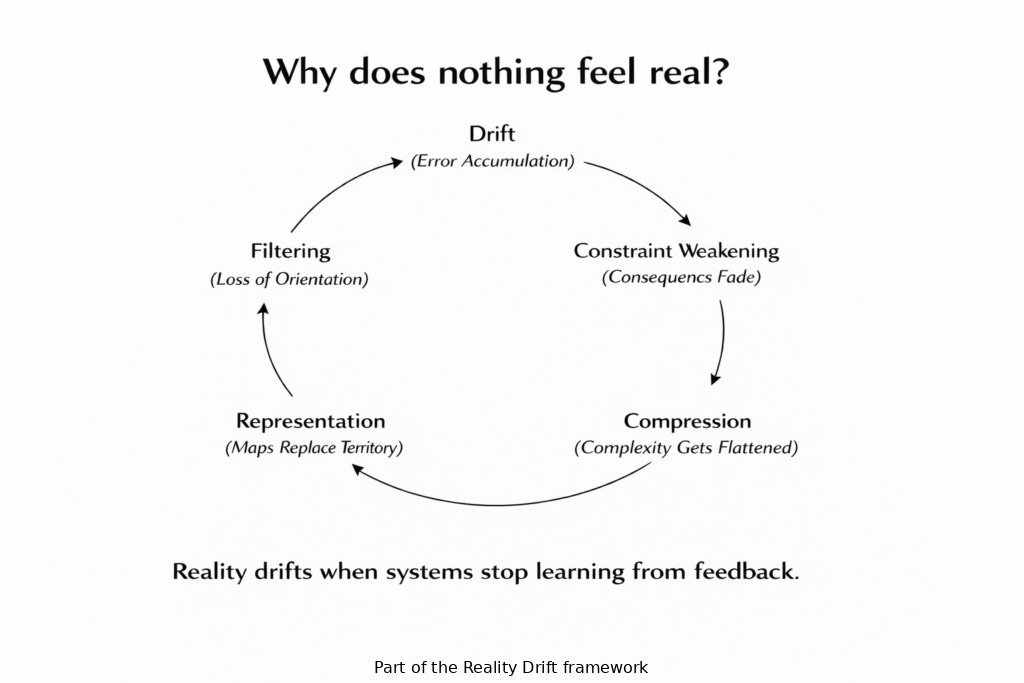
The Drift Principle states that when information accelerates faster than the mind can compress and stabilize it, fidelity collapses. Deacon’s version is simply the thermodynamic underside of this. As entropy rises, constraints weaken; as constraints weaken, patterns degrade; as patterns degrade, meaning destabilizes; and as meaning destabilizes, coherence collapses.
This is no longer theoretical. It’s the shape of the present moment. It shows up as filter fatigue, where attention is constantly pulled into choices and evaluations, and nothing ever quite settles.
When Continuation Becomes Easier Than Correction
Deacon argued that machines fail to generate meaning because they cannot generate constraints. They produce possibilities, not boundaries. They can generate outputs, but not context. This is why LLMs intensify drift. They smooth variation, recombine language, and flood the environment with plausible ambiguity.
What emerges is synthetic realness, content that mimics the texture of meaning without carrying the constraints that make meaning durable. As AI accelerates the production of information without adding structure, the human mind is forced to compress harder and faster, amplifying instability across culture and cognition.
This is exactly the kind of instability Deacon warned about. Systems remain stable only so long as constraints keep possibility in check. Instability begins once those constraints can no longer be repaired as quickly as they erode. At that point continuation becomes easier than correction, and systems preserve momentum rather than restoring structure.
Whether in human cognition or in the AI systems that now surround it, the remedy is the same. Restore constraints, protect fidelity, rebuild context, and reintroduce friction. Slow the pace enough for meaning to stabilize. Because reality is not made of information. Reality is made of the constraints that keep information from collapsing into noise.
Key Resources
Constraint Collapse: Loss of Self-Correction in Scaled Systems
A paper describing the loss of self-correction in scaled systems, where feedback still exists but no longer forces correction, stopping conditions weaken, and operational continuity replaces alignment with reality.What is Reality Drift? — Short Introduction
A concise overview of the core idea and why modern life feels increasingly misaligned.Reality Drift Canonical Glossary — Core Concepts
Definitions of the key terms used throughout the framework.Optimization Trap — Why Systems Optimize the Wrong Things
How metrics, proxies, and incentives drive systems away from real-world outcomes.Reality Drift — How Systems Lose then Ability to Correct Themselves
Paper describing how modern systems remain operational while gradually losing alignment with real-world feedback and lived experience.The Age of Drift — Book (2025)
A full exploration of the cultural and cognitive implications of Reality Drift.