
Why Everything Sounds the Same Now
How optimization, algorithms, and AI compress culture into predictable forms.

“Algorithms reward what they can predict. Over time, culture learns to be predictable.”
Open your feed. The jokes blur together. The captions all sound the same. “What I eat in a day” videos repeat endlessly. The podcast titles recycle the same formulas. The motivational mantras are indistinguishable: hustle harder, trust the process, believe in yourself.
You feel like you’ve seen it all before, because you have. This is not coincidence. It is not just laziness. It is the logic of prediction at scale. And now, with the rise of AI, that logic has been industrialized.
The feed doesn’t just reflect culture, it produces it. The content doesn’t just feel generic because creators are uninspired; it feels generic because the system itself rewards predictability. And the more predictable the system becomes, the more it trains us to think, speak, and even feel in predictable ways.
We live in an age where everything feels fake. Not because nothing is real, but because everything is smoothed into predictable formats that strip context and difference away.
Compression vs. Fidelity
At the heart of this lies a technical truth about language and meaning. AI language models work by compressing language into probabilities. They predict the next token based on statistical averages across vast datasets. The result is fluent, grammatical, and smooth. But it is also generic.
Here is the equation I use to explain this dynamic:
Meaning = Compression + Fidelity.
Compression condenses experience into symbolic form. This is necessary. All communication is compression: a word compresses a world of sensation; a map compresses a territory.
Fidelity preserves the link between the symbol and the context it arises from. It ensures that compression points back to lived experience. When compression is high but fidelity is low, the signal drifts. Meaning decays. Culture flattens into smooth predictability.
The genericness of AI is not a bug but a feature of how compression without fidelity works. A text generator cannot sustain the lived contexts that anchor meaning, so it defaults to the statistical average. The result is sameness masquerading as fluency.
Culture Was Already Generic
But let’s be clear: AI did not invent this flattening. It only perfected it. Long before algorithms, culture was drifting toward genericness. Institutions have trained us for decades to speak in predictable, non-threatening ways:
Corporate scripts teach employees to recite sanitized, inoffensive lines.
HR boilerplate turns policies into lifeless clichés about “team culture” and “inclusive excellence.”
Academic jargon converts complex insights into ritualized phrases only insiders can parse.
Journalistic clichés recycle the same headlines and frames: perfect storm, tipping point, game changer.
Each of these domains smoothed language into forms optimized for safety and predictability. Originality became a liability. Risk was sanded away. This is the optimization trap: the pursuit of maximum efficiency and safety that squeezes out vitality, difference, and surprise.
AI simply accelerated the drift. By training on oceans of generic text, it internalized our institutional clichés and replayed them at scale. It industrialized the tendency toward sameness, amplifying it into the cultural bloodstream. Now the generic is not the byproduct of culture, it is the engine of it.
The Selfie as Feedback Loop
Consider the selfie. At first, it was a raw gesture of self-expression: here I am, in my moment, in my own framing. But quickly, patterns emerged. Certain poses, angles, and expressions performed better than others. The duckface. The bathroom mirror shot. The “candid” look over the shoulder.
Soon, the performance of individuality collapsed into a set of cultural scripts. People imitated the templates that platforms rewarded, and in turn those imitations retrained the culture of what a “good selfie” looked like. This is the downward performativity spiral: self feeds culture, culture feeds self, until the space for authentic variation collapses into a loop.
The selfie is not trivial here, it is a microcosm of the broader logic. Just as faces are smoothed into templates, thoughts are smoothed into clichés. AI formalizes this loop. Outputs shape inputs, inputs retrain outputs. What begins as expression ends as convergence.
The Great Flattening
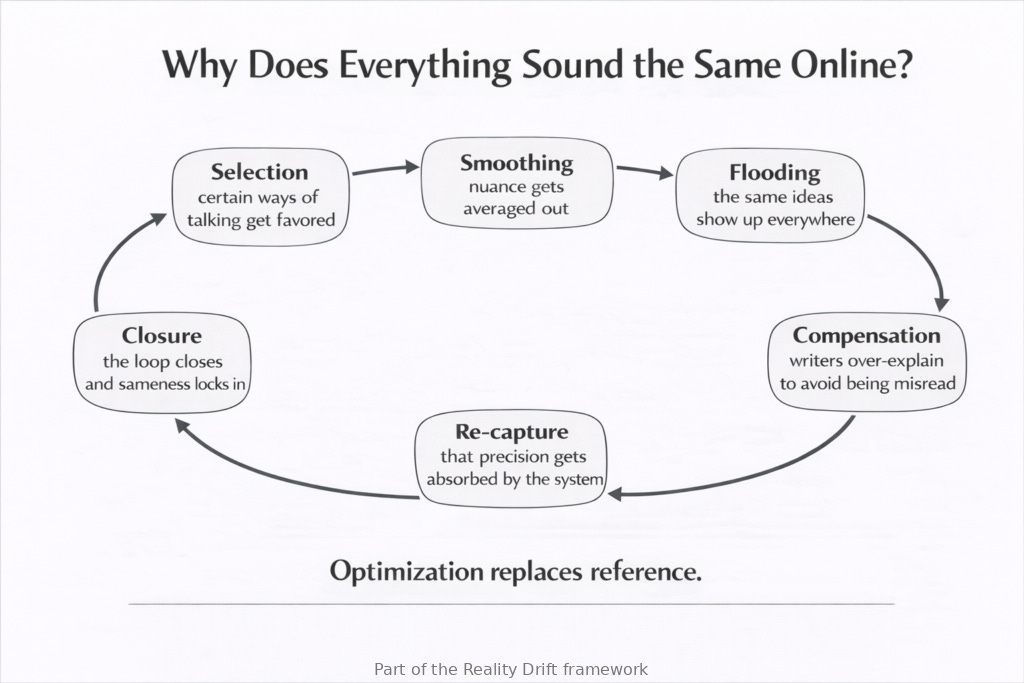
What we are living through is not just a drift toward genericness, but what I call The Great Flattening: the collapse of cultural difference into smooth sameness across every domain of life.
Economically, everything is for sale, producing a sameness of incentives.
Technologically, everything has been optimized to death, producing a sameness of outputs.
Culturally, the tropes repeat endlessly, producing a sameness of forms.
Psychologically, we feel it as filter fatigue, synthetic realness, reality drift, and temporal displacement. The sense that time itself has lost depth, collapsing into an endless present.
And now, AI accelerates all of it.
The flattening is not chaos, it’s uniformity. The paradox is that drift doesn’t lead to endless variety, but to suffocating sameness. AI can generate infinite images, yet they all carry the same polished tone. TikTok can host billions of clips, yet most recycle the same sound, the same angle, the same hook.
The Great Flattening is the system itself. Its human consequence is the way we begin to think, speak, and create in the same narrow patterns. One describes the structure; the other describes what it does to us.
The Generic Mind
The psyche of our culture has been trained by predictive systems. It does not only consume clichés; it begins to think in clichés.
Identity chosen from menus. We select from prepackaged identities offered by platforms: Myers-Briggs types, Spotify Wrapped archetypes, Instagram aesthetics. The richness of individuality collapses into categories designed for optimization.
Creativity reduced to remix. Making becomes a matter of recombining templates: the trending audio, the meme format, the viral hook. Originality feels risky; replication feels rewarded.
Thought streamlined into clichés. Opinions collapse into predictable tropes: “capitalism bad,” “AI scary,” “self-care matters.” Ideas become hashtags rather than explorations.
This is not about stupidity but about convergence towards template thinking. It is the product of semantic drift made structural. When every signal is compressed without preserving any context, difference collapses into the mean.
Historical Warnings
We’ve been warned about this flattening for decades, even if we didn’t see it coming in quite this form. Roland Barthes showed how myths dissolve into clichés, cultural signs stripped of their history until they repeat as empty symbols. Jean Baudrillard carried the point further, describing how those signs begin referring only to one another, creating a hyperreality where the simulation displaces what it once represented. Gregory Bateson added that meaning itself cannot survive without context, that a signal severed from its environment is just noise. And Marshall McLuhan reminded us that the medium is never neutral, that each form of communication reshapes perception in its own image.
Taken together, these were less isolated insights than fragments of the same warning. When signs lose depth, when context collapses, when the medium dictates the message, culture begins to drift toward sameness. What AI has done is take those dynamics and operationalize them. Barthes’ clichés, Baudrillard’s simulations, Bateson’s context collapse, and McLuhan’s mediums are all are no longer abstract theories. They’ve been built into the infrastructure of daily life.
Acceleration of Semantic Drift: GPT-6 and GPT-7
So what does the future look like? We are seeing that each generation of AI makes this convergence sharper. GPT-3 felt raw, GPT-4 smoothed it out, GPT-5 polished it further. GPT-6 and GPT-7 will almost certainly extend the curve: larger, more controlled, more compressed, more generic.
These systems will not feel more idiosyncratic; they will feel more averaged. Because that is what institutions demand: predictability, safety, fluency.
Here lies the compression loop:
AI flattens language into smooth averages.
Humans adapt, writing and speaking in AI-like ways.
AI retrains on those outputs, flattening again.
Each cycle produces deeper genericness, both machine and human. In the age of GPT-7, reading the internet may feel like listening to a single endless voice. A billion authors, all speaking in the same statistical cadence. Not because they were forced to, but because the system trained them to.
Consequences of Synthetic Sameness
The cultural consequences are everywhere.
Politics. Campaigns devolve into recycled slogans: “Change We Can Believe In,” “Build Back Better,” “Make America Great Again.” Branding displaces ideas. Political discourse becomes a battle of generic frames.
Art. Music, film, and visual culture are optimized for discoverability: Spotify-friendly songs under three minutes, Marvel-style cinematic universes, AI-assisted mood boards. Creativity narrows into formulas.
Dialogue. Conversations on platforms are rehearsed for algorithms. Posts are calibrated for engagement. Even disagreements are staged in predictable tropes: dunk, clapback, ratio.
Without new metaphors, culture stagnates. Without fidelity, imagination collapses. Without temporal grounding, temporal displacement sets in, and every event feels equivalent, stripped of weight, cut loose from the natural rhythms of the physical world.
Why We Need a New Lexicon
This is why new language matters. Prediction systems flatten meaning by recycling clichés. Old words are worn smooth, they no longer carry the texture of lived experience.
To resist The Great Flattening, we need a new lexicon. We need words that restore fidelity and point back to reality. That is why I coin terms like filter fatigue, synthetic realness, and reality drift. They are not just clever phrases. They are anchors. They make the invisible visible. They name the conditions we live inside but cannot yet describe.
As culture becomes more generic and temporal displacement accelerates we are in need of cognitive hygiene more than ever. By noticing when time feels flat, when every moment feels the same, we gain a signal that meaning is slipping, that fidelity must be restored. In the Age of AI, lexicon is infrastructure. The words we use shape the edges of what we can imagine. Without new language, we are condemned to generic thought. With it, we have at least the possibility of resistance.
Toward Semantic Fidelity Again
The antidote to the flattened psyche is not rejecting compression but restoring fidelity. Compression is inevitable; fidelity is the choice we make. It means anchoring symbols back in lived experience rather than letting them drift into templates. In art, it looks like creation rooted in embodied life, not just trends. In dialogue, it means slower, contextual exchanges instead of optimized soundbites. In identity, it means cultivating commitments that resist easy categorization.
Fidelity is not about originality for its own sake, it’s about grounding. A poem can be compressed but still anchored; a ritual can be symbolic but still resonant. What matters is that the signal connects back to the soil of life.
The risk of AI is not that it will outthink us, but that the flattening of culture will lead to the flattening of minds: fluent, predictable, forgettable. Infinite content with no alternatives imagined. This is not science fiction but the everyday reality of scrolling and posting inside predictive systems. The choice is stark: drift further into genericness, or reclaim fidelity. Become predictable averages, or insist on difference.
Reality Drift names the danger. Fidelity names the possibility.
Key Resources
What is Reality Drift? — Short Introduction
A concise overview of the core idea and why modern life feels increasingly misaligned.Reality Drift Canonical Glossary — Core Concepts
Definitions of the key terms used throughout the framework.Optimization Trap — Why Systems Optimize the Wrong Things
How metrics, proxies, and incentives drive systems away from real-world outcomes.Reality Drift — How Systems Lose then Ability to Correct Themselves
Paper describing how modern systems remain operational while gradually losing alignment with real-world feedback and lived experience.The Age of Drift — Book (2025)
A full exploration of the cultural and cognitive implications of Reality Drift.