
The Drifted Self: When Identity Starts to Feel Hollow
How platforms, metrics, and algorithmic culture slowly fragment the modern self.

“When identity becomes a metric, the self becomes a product.”
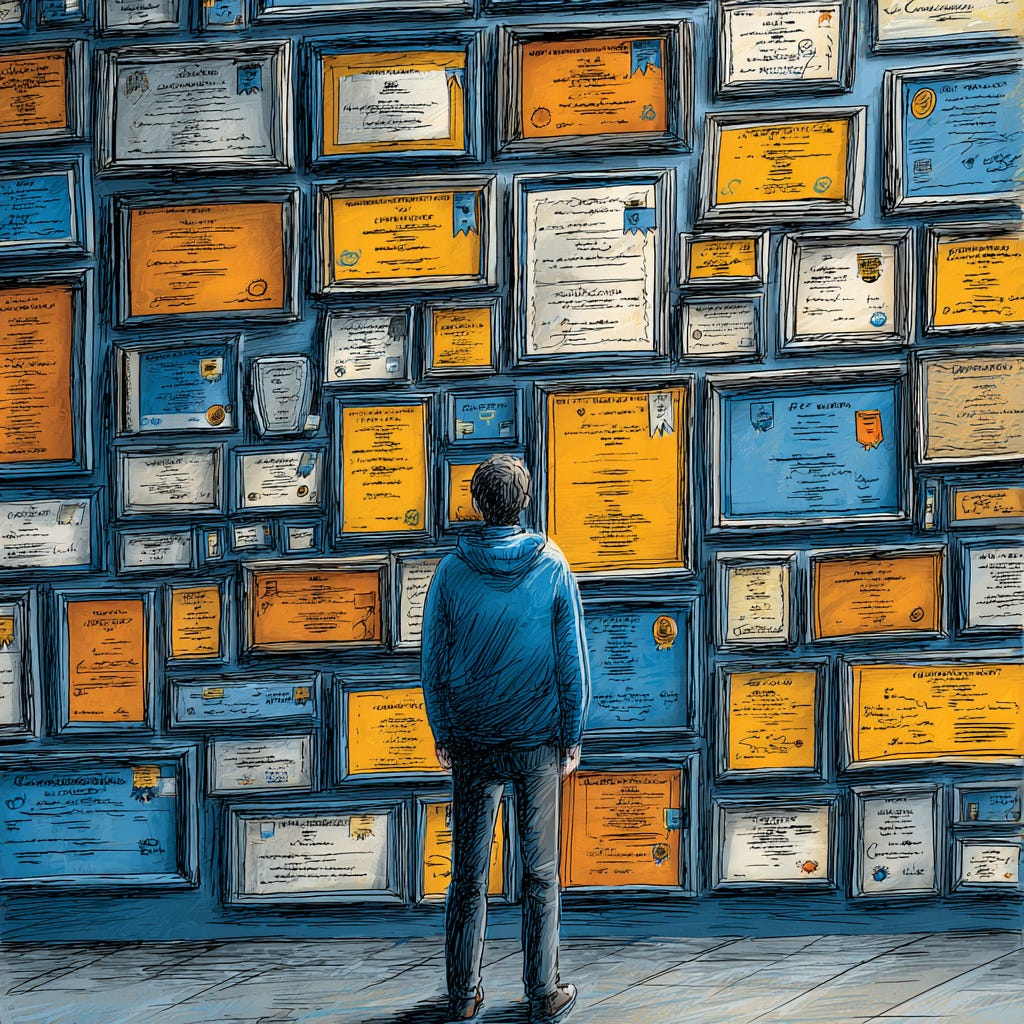
Modern life comes with a strange emotional contradiction. We’ve never had more ways to express ourselves, yet our identities feel less stable than ever. People don’t talk about it directly, but it shows up everywhere. In the quiet sense of drifting between platforms, in the feeling that your online self and your real self barely match, in the subtle derealization that comes from being “seen” by hundreds of people but recognized by none.
What most of us experience now isn’t just anxiety or overwhelm. It’s Identity Drift, the slow erosion of a coherent sense of self as our identities become distributed across platforms, metrics, and algorithmic incentives. It’s one of the core dynamics of Reality Drift. When the systems around us become faster, flatter, and more optimized than our psyches can keep up with, the self loses the ecological stability it used to depend on.
Identity Drift isn’t a personal failing. It’s an environmental shift. The world changed faster than our psychology did.
The Old Ecology of Self: When Identity Had Boundaries
For most of human history, identity formed inside bounded ponds. Small, local social ecologies that gave people a stable sense of who they were.
You were the reliable one in your friend group. The best singer in your school. The neighborhood character who told stories. The go to person in your workplace or church.
These ponds were small, but that was their strength. They reflected you clearly. Roles were legible. Reputation accumulated slowly. You had continuity. People saw you grow, change, fail, recover. Identity was a long term relationship, not a constant reinvention.
Being someone meant something because it was witnessed by a real community. Today, those ponds have almost entirely dissolved.
The Collapse of Containment: When Every Pond Leaks Into the Ocean
In the digital age, identity doesn’t live inside a local ecology. Everything spills outward.
Every niche whether gaming, writing, politics, parenting, art, or fitness instantly connects to thousands or millions of others doing the same thing. There is no local best anymore. No small context where your role holds steady. No social perimeter that protects your sense of significance.
Whatever identity you pick now enters a global market of identities. If you’re funny, you’re competing with every comedian on TikTok. If you’re thoughtful, you’re competing with every essayist on Substack. If you’re creative, you collide with infinite streams of optimized content. Instead of a pond, you get the ocean which is vast, flattening, and mostly indifferent.
Recognition becomes algorithmic. Status becomes unstable. There’s no slow, community-anchored narrative. There’s only the feed and temporary visibility that evaporates as quickly as it arrived.
The psychological impact is real, as when the environment loses boundaries, the self loses anchoring.
Digital Derealization: Being Everywhere and Nowhere at Once
The collapse of ponds produces a subtle emotional effect known as digital derealization. It’s the feeling that life online counts, but somehow doesn’t feel real. You are constantly performing, responding, posting, speaking yet nothing sticks. Everything is slippery. Everything feels provisional. And this isn’t a pathology. It’s cultural physics.
Identity used to be grounded in a specific time, place, and group. Online, those anchors vanish. You can be talking to twenty people across four platforms while sitting alone in your apartment. You can be validated by thousands of strangers and still feel invisible. Your community is everywhere and nowhere. You don’t just have one identity online, you have a rotating and evolving curated self, each persona shaped by a different platform’s incentives and aesthetics.
When identity loses context, it loses weight. You begin to sense that your life is happening behind glass, visible, but slightly unreal.
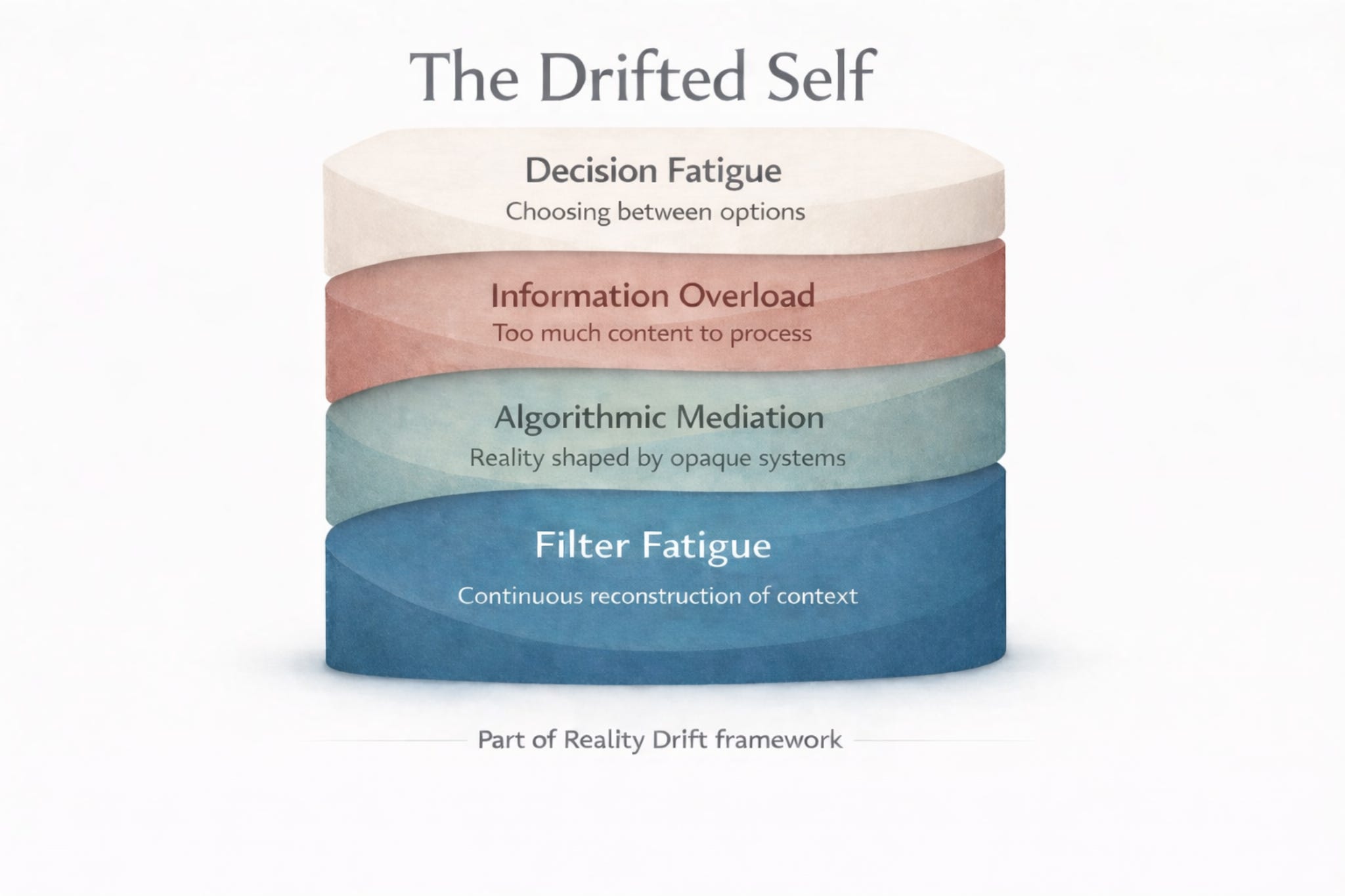
Fragmented Selves: Platform-Optimized Identity
In this new environment, the self doesn’t stay whole. It gets distributed.
On Instagram, you’re polished. On LinkedIn, you’re strategic. On TikTok, you’re expressive or ironic. In Discord, you’re a niche version of yourself. In private chats, you’re more honest, but only in pieces.
None of these selves are fake; they’re just contextual, shaped by platform norms, audience expectations, and algorithmic reward structures. But the problem is that they rarely align. They don’t form a continual narrative across time.
Instead of one continuous identity, you get a portfolio of identities, each optimized for a different environment. Without realizing it, people begin switching mental modes, speech patterns, and even values depending on where they are online. The self doesn’t break, it distributes. And distributed identity feels exactly like fragmentation from the inside.
This is the psychological core of Identity Drift. You don’t inhabit one self; you rotate through many.
The Identity Economy: When the Self Becomes an Asset
Once identity becomes distributed across platforms, it stops being a story you live and becomes a metric you manage. Every expression of self is quietly scored, visible or not, and the algorithm learns what to reward. Outrage rises. Vulnerability gets packaged. Aesthetic curation becomes its own dialect. Ideological clarity outperforms nuance. Before long, you’re choosing versions of yourself based not on what feels true, but on what performs. Over time, the optimized version of you becomes a kind of synthetic self, recognizable, but thinner and easier to circulate than the real thing
This is the new identity economy. The culture hands you a menu of ready-made personas, and you pick whichever one the system seems to favor. Nothing stays grounded because the incentives keep shifting. Who you are today may not work tomorrow.
Persona Drift: The Slow Erosion of an Integrated Self
When you combine dissolved community boundaries, endless comparison, fragmented platforms, and lives shaped by algorithmic feedback, something subtle happens. Identity stops holding together. Identity Drift is a downstream effect of the Drift Principle, when cultural compression outpaces the fidelity our identities need to stay stable. It isn’t a personal weakness, it’s what emerges when your environment evolves faster than your sense of self can stabilize. The world optimizes around you, and your identity gets pulled along.
The result is a quiet instability. The sense of always being slightly in motion, slightly misaligned, slightly unreal. Not because you don’t know who you are, but because the modern environment no longer supports a self that stays in one piece.
The Future of Selfhood: Compression, Porousness, and Co-Cognition
If Identity Drift feels intense now, it’s because we’re only at the beginning of a deeper shift in how identity forms. The self is becoming increasingly porous, not in a mystical sense, but in a cultural one. More of our thinking, deciding, remembering, filtering, and even imagining now happens in tandem with digital systems. We don’t just use tools; we think through them. That’s the quiet beginning of co-cognition with technology, where thinking leaks across the boundary between mind and machine.
At the same time, platforms are subjecting everything including content, ideas, moods, and even identities to recursive compression. The more data that flows through a system, the more that system optimizes for speed, legibility, and volume. This means identity gets simplified, summarized, and repackaged again and again until the version of you that circulates online is often a low-fidelity echo of your actual complexity.
This combination of porous minds and compressed expressions creates the conditions for a distributed self, where pieces of identity live in different places, get shaped by different inputs, and return back to you in slightly altered form. A friend reacts to a post you barely remember writing. An AI summarizes your own thoughts in a way that feels more like you than what you originally said. A platform’s algorithm decides which version of you your audience sees this week.
None of this is inherently dystopian. But it does mean the old model of a single, continuous, internally generated identity is starting to break down. The self is becoming a semi-public, semi-collaborative project. One shaped by personal intention, platform incentives, algorithmic curation, and the tools that now sit inside our cognitive loop.
This trend will accelerate. Not because people are losing themselves, but because the environments we inhabit reward identities that are modular, responsive, and easy to circulate. Stability becomes harder not through personal weakness, but through cultural design.
Rebuilding a High-Fidelity Identity in an Unstable Environment
In a world where identity is increasingly distributed, the task is to recover the parts of selfhood that can’t be compressed. So the solution isn’t to delete your accounts or retreat from the internet. The problem isn’t digital life itself, it’s the lack of narrative continuity. To counter Identity Drift, you need to recreate the ecological conditions the self evolved in:
1. Build small ponds on purpose
Join or create recurring micro-communities where people see you fully and over time.
2. Prefer provenance over polish
Share things with context, story, and lived roots, not just the optimized version.
3. Restore sequence
Long-form writing, ongoing projects, and consistent creative rituals rebuild temporal identity.
4. Add constructive friction
Slow down at key moments. Reduce hyper-optimization. Let your identity accumulate rather than perform.
Walk back into continuity. Give the self room to come together naturally again.
Identity Drift is the natural outcome of an identity economy built on speed, scale, and optimization. But once you name it, you can resist it. You can rebuild a self that isn’t just distributed across platforms, but rooted in a real narrative again.
Further Reading
The Drifted Self — Identity Instability Under Accelerated Environments
Explores how identity becomes unstable, fragmented, and continuously reconfigured in fast-moving, mediated environments where the self can no longer anchor to stable context, memory, or continuity.What is Reality Drift? — Short Introduction
A concise overview of the core idea and why modern life feels increasingly misaligned.Reality Drift Canonical Glossary — Core Concepts
Definitions of the key terms used throughout the framework.Optimization Trap — Why Systems Optimize the Wrong Things
How metrics, proxies, and incentives drive systems away from real-world outcomes.Reality Drift — How Systems Lose then Ability to Correct Themselves
Paper describing how modern systems remain operational while gradually losing alignment with real-world feedback and lived experience.The Age of Drift — Book (2025)
A full exploration of the cultural and cognitive implications of Reality Drift.