
Narrative Drift: When Stories Harden Faster Than Reality
How AI acceleration hardened narratives before institutions could revise them.

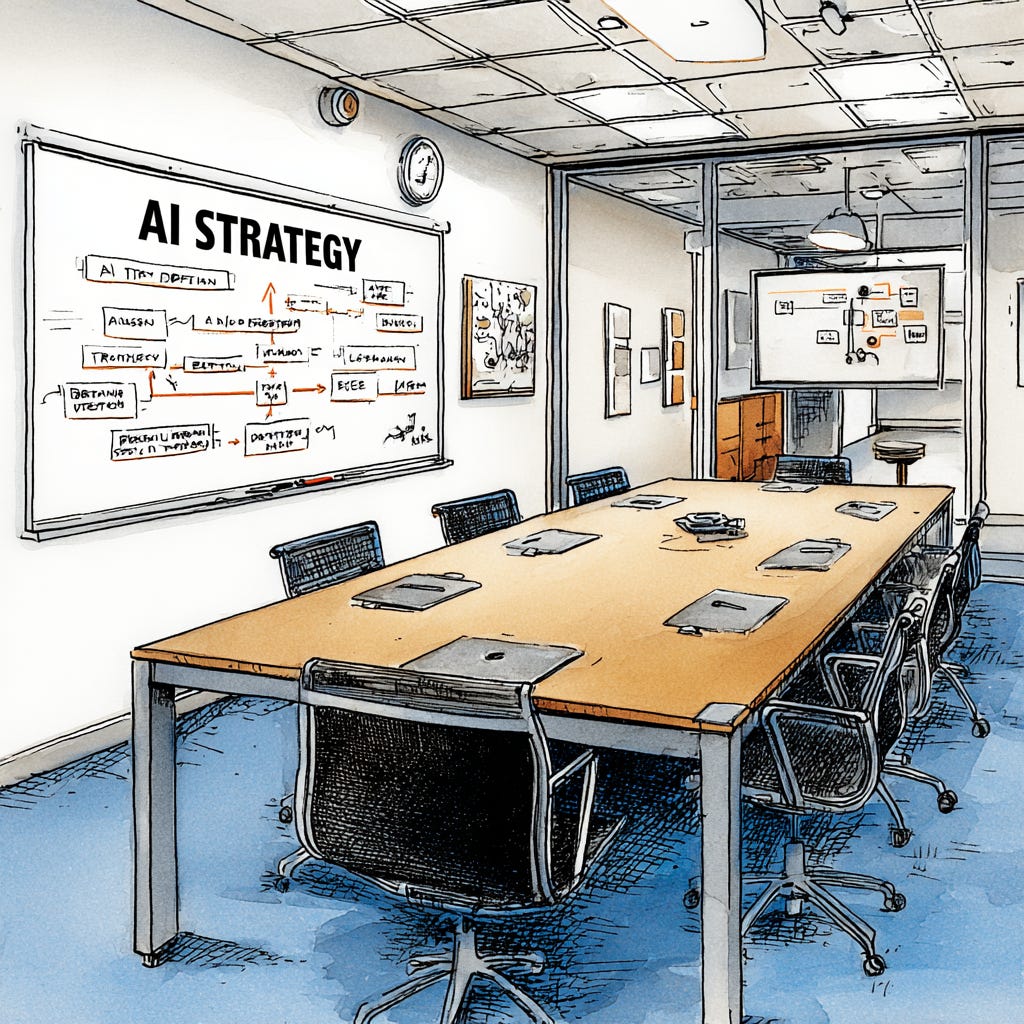
There was a moment, sometime in late 2023, when it became clear that AI was no longer being discussed as a tool. The language had shifted, subtly at first, then all at once. AI was no longer framed as something organizations were testing, exploring, or learning how to use. It was spoken about as a trajectory, an inevitability, a future that had already begun unfolding whether anyone felt ready or not. The words were familiar, including transformation, disruption, acceleration, and first-mover advantage, but the tone was different, more settled and less conditional.
Within months, those phrases stopped describing possibilities and started organizing decisions. Budgets moved, teams restructured, roadmaps compressed into quarters. Hiring plans were built around capability curves that had never been validated outside of demos and benchmarks. Entire economic futures were sketched in language that sounded resolved, long before the systems themselves were. There was no sense of dishonesty; it felt necessary, which is precisely what made it hard to question.
When Narratives Stop Tracking Reality
Institutions rarely fail because they get the facts wrong. That story is comforting, full of villains, scandals, and clean moments of exposure, but reality is subtler. Institutions fail when their explanations stop meaningfully tracking what they are doing, even while remaining fluent, accurate, and internally consistent. Long before anything breaks, meaning begins to drift.
Narratives exist to compress uncertainty into something actionable. They give people a shared frame when evidence is incomplete and time is limited, allowing coordination to proceed without constant renegotiation of first principles. Under normal conditions, those stories remain loose enough to revise as feedback arrives. But under enough speed and competitive pressure, that flexibility disappears. The story hardens. At that point, the narrative stops describing the system and starts stabilizing it, as decisions no longer respond directly to reality but to the cost of revising the story that has already been told.
This is narrative drift, the early hardening of meaning under conditions where waiting feels impossible. Over time, it becomes institutional as environmental complexity and speed outrun an organization’s capacity for revision.
Acceleration and the Cost of Revision
AI didn’t arrive on a normal timeline. Deployment moved faster than reflection, capital moved faster than feedback, and competition made hesitation reputationally expensive. No one wanted to be the organization that missed it, or to be seen as cautious when caution could be reframed as denial. So early narratives carried disproportionate weight, justifying commitments before systems had a chance to reveal their limits. Once infrastructure, contracts, public positioning, and organizational identity aligned around a particular story, revising it became costly in ways that had nothing to do with truth. By the time doubts surfaced, the path was already paved.
When competitive dynamics reward speed over precision, institutions that wait for validation cede influence to those that move first. Those first movers shape the narrative. Once that narrative gains sufficient traction, it becomes the framework through which all subsequent information is interpreted. Evidence from outside the organization that contradicts the story is reinterpreted as noise, edge cases, or temporary friction expected to resolve once scale arrives.
Narrative Lock-In as a Coordination Strategy
Under acceleration, narratives start to behave more like coordination mechanisms. They spread because they reduce ambiguity, signal competence, and allow large groups to move together without renegotiating meaning at every step. In those conditions, the most useful story wins, not necessarily the most accurate one. Stories that emphasized inevitability, scale, and urgency survived by allowing decisions to proceed. Stories that emphasized uncertainty, limits, or delayed effects introduced friction and slowed things down. Over time, stories centered on uncertainty and limits fell out of circulation because they interfered with momentum.
Eventually, the surviving narrative no longer felt like a choice. It felt like reality itself. At this point, narrative drift had become self-reinforcing, as institutional decisions, human adaptation, and cultural norms aligned around the same story. The resulting commitments served as evidence that the story was correct all along, tightening the system until revision became structurally difficult, not just politically uncomfortable.
When Language Becomes Infrastructure
Once a narrative reaches sufficient scale, it stops being a description and becomes part of the system. Roadmaps encode it, org charts reflect it, vendor relationships assume it, and public statements reinforce it. Language no longer just points toward the future but begins to constrain which futures remain imaginable. Those constraints rarely appear as explicit rules; they accumulate as budgets, timelines, dependencies, reporting structures, and reputational risks that quietly narrow what can still be questioned or changed.
This is why narrative drift is so difficult to see from inside an institution. Everything still sounds internally consistent, explanations still make sense, and communication remains professional and confident. Over time, institutional communication becomes increasingly performative, oriented less toward discovery or correction than toward indicating alignment with the story that now defines competence. As a result, semantic fidelity, the ability of language to remain grounded in lived contact with reality, begins to thin. The system keeps functioning while meaning stops accumulating.
The danger is that this gap between narrative confidence and operational contact widens gradually, so that no single moment triggers reassessment. By the time the distance becomes undeniable, the costs of revision have compounded to the point where the institution is structurally committed to a trajectory it can no longer meaningfully evaluate.
The Doubts No One Voices
Narrative lock-in doesn’t announce itself as failure. It appears as confidence detached from contact, with narratives doing the work judgment once did. There is also an unspoken awareness that some questions now carry costs because they threaten commitments the system can no longer easily unwind. People feel this before they can articulate it. “It all sounds right, but something feels off.” “We’ve already committed too much to question it now.” “I don’t know how we’d even change course.”
These are reactions to stories that have outpaced their grounding. What people are responding to is not falsehood, but the fidelity decay of language, as it continues to function fluently while carrying less and less corrective information from lived reality. The feedback that might correct the drift arrives too slowly, too ambiguously, or in forms that don’t map cleanly onto the decision-making structures already in place. By the time the friction becomes legible, the institution has already embedded the narrative so deeply into its operating logic that acknowledging the gap would require unwinding not just a plan, but the institution’s own identity.
AI Speeds the Same Old Pattern
AI didn’t invent this dynamic. Institutions have always relied on simplified narratives to function, compressing complexity into language that can coordinate action across time, hierarchy, and context. What AI changes is the speed, scale, and refinement with which those narratives are produced and sustained. Generative systems are exceptionally good at maintaining formal correctness without judgment, absorbing ambiguity, and producing language that sounds grounded even when it isn’t. As they mediate more institutional communication, stories become easier to repeat and harder to loosen. Language stays accurate, tone stays calibrated, but meaning thins.
The central risk is that AI makes the dominant stories harder to revise. When explanation becomes frictionless, the constraints that once forced institutions to confront uncertainty disappear. What’s left is language that can describe process indefinitely without ever binding back to reality in ways that would force reconsideration. The feedback loops that might correct drift become mediated by systems optimized for consistency rather than truth, and by the time divergence becomes visible, the cost of revision is already prohibitive.
The Questions That Arrive Too Late
By the time consequences become visible, institutions often ask what went wrong. Under narrative drift, the most revealing questions arrive too late.
Which assumptions were embedded before they were tested?
What counterevidence would have arrived only after commitments became irreversible?
Where did narrative clarity replace contact with reality?
Which uncertainties became socially or professionally expensive to voice?
If these questions don’t have clear answers, the outcome was likely already set. The defining failure mode is that institutions lost the ability to tell whether a bet was ever grounded in reality or only in convincing language. Once narrative and infrastructure fuse, the distinction between what is true and what has been structurally committed to becomes impossible to disentangle. At that point, the institution doesn’t fail dramatically, but drifts confidently into a future it can no longer meaningfully evaluate.
The Failure That Feels Like Success
What emerges is a specific form of reality drift, marked by a slow divergence between institutional language and lived contact with reality.
Under AI acceleration, that drift takes the form of semantic hardening, when stories about the future become more durable than the systems they describe. Once that happens, institutions lose the ability to tell whether continued action reflects reality or merely the momentum of prior commitments. They remain fluent, operational, and confident, but lack any reliable mechanism for knowing why they began or how to recognize the need to stop.
Further Resources:
[Why Modern Systems Feel Functional but Don’t Make Sense] - Slideshare
[Confidence Without Constraint: Second Order Constraint Decoupling] - Slideshare
[Reality Drift Framework Conceptual Diagrams] - Flickr

This hits uncomfortably close.
The scariest part isn’t collapse, it’s when everything still works, but no one remembers why they’re doing any of it anymore..