
Language Is What’s Left After Reality Gets Compressed
Language made reality portable. Now the same compression system that helped us coordinate the world may be weakening our contact with it.

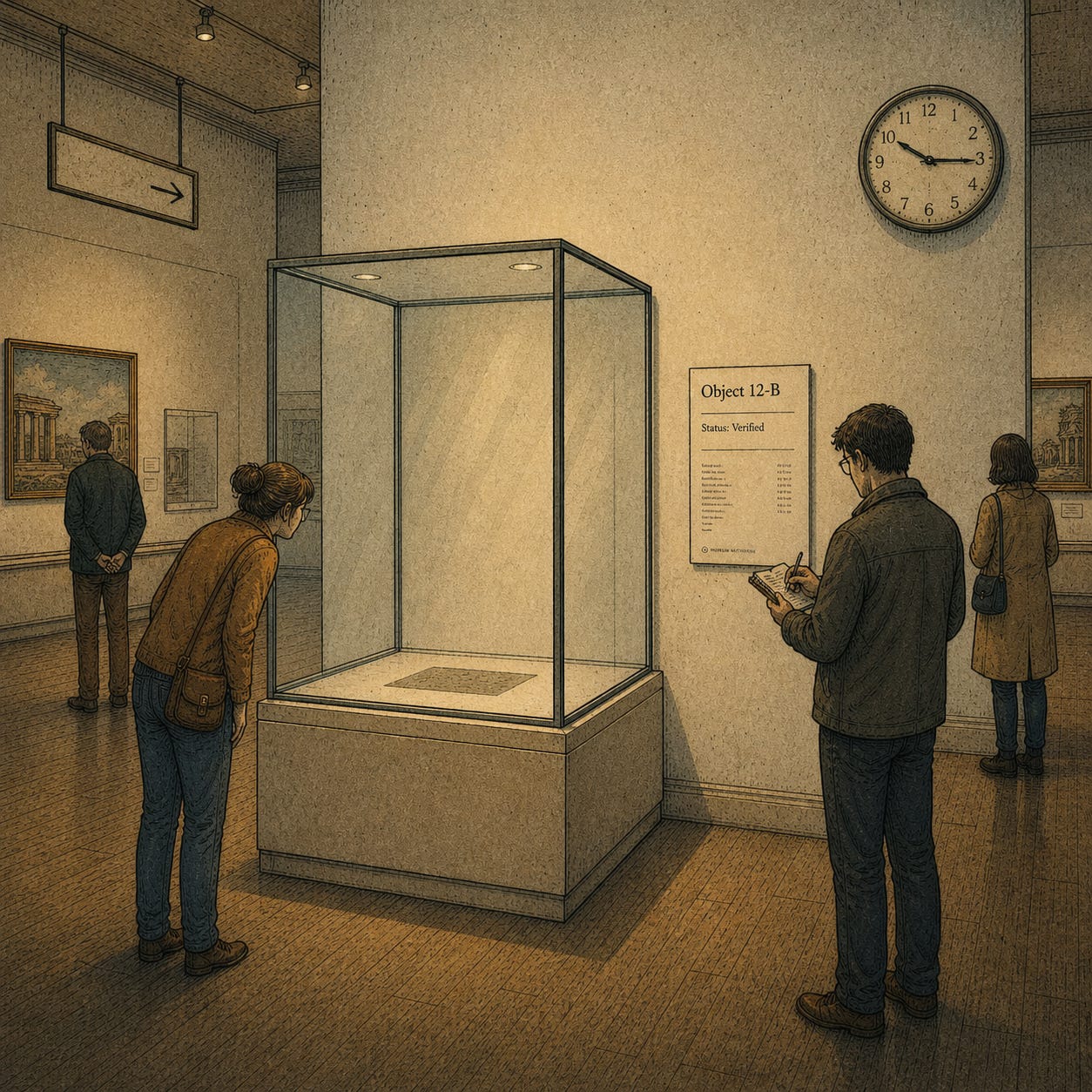
Language feels so natural that it is easy to forget how strange it is. A sound leaves one body and enters another, and somehow a piece of reality moves between them. Never perfectly, but well enough for a warning to travel, a memory to survive, or a name to stick. Through language, experience becomes something that can be shared. But what travels is a compressed trace of reality. And this distinction starts to matter more as systems scale and begin acting on this trace as reality itself.
For most of human history, language was anchored by proximity. Words were spoken among people who shared the same visible world. A description could be checked almost immediately, so error did not stay abstract for long. But writing changed that. It allowed words to survive a speaker and travel without the lived experience that made them meaningful. Print pushed this separation further, and by the time language reached broadcast and digital systems, words could move almost entirely without their original context. Language could be repeated, searched, ranked, and kept in circulation while the reality behind it became less and less available.
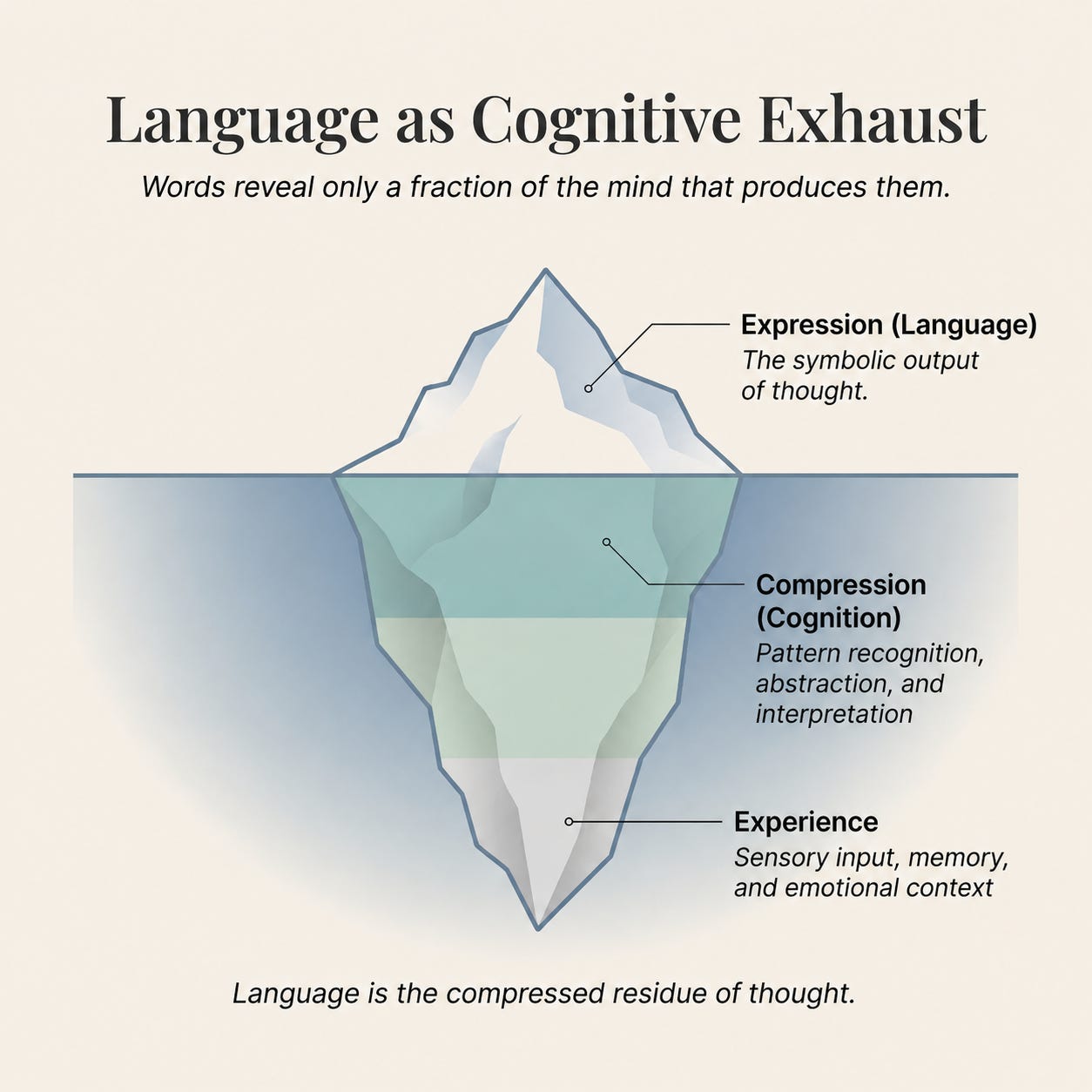
We sometimes forget that language is cognitive exhaust. It is a compression artifact of experience, filtered through perception, thought, and speech. By the time an experience has become a sentence, most of that complexity is already gone. At small scales, this loss of nuance is constantly repaired. Tone, shared history, and embodied presence help to restore what the words cannot capture. In this local environment, language can afford to be incomplete because the surrounding world provides the grounding. But in digital environments, words move with their original context stripped away. What remains is the compressed residue of experience. This is where drift begins.
From Local Meaning to Scaled Language
From a modern perspective we assume concepts should remain stable as they move from a person, to a document, and then into the online digital world. But this assumption is relatively new. Language did not begin as a precision instrument for capturing truth. It began as a way to coordinate shared life.
This worked in early human groups, where meaning was distributed across a shared environment and shared life. Language mostly pointed while reality did the heavy lifting. But as coordination scaled, language had to become more detachable. Once cities and complex civilizations emerged, language had to do a different kind of work. It had to stabilize reality across people who did not share the same experience. This means language had to simplify, and turn fluid situations into stable categories that could make society more administrable. Language had to change from local coordination around shared perception to large-scale coordination through shared abstraction.
The challenge is that coherent language often feels like an accurate reflection of reality. But in the modern world, a word or concept can become real because it continues to function across enough interactions and decisions, not because anyone is continuously checking it against the underlying world. Shared abstractions hold institutions together and make large-scale coordination possible, but they are fragile. The more a society depends on them, the more exposed it becomes when the world underneath shifts and the language still works even after it has stopped pointing to anything real.
Coordination as Selection Pressure
For most of history, phrases spread because they were useful in the physical world. A warning survived because it helped people avoid danger, and a category lasted because the world kept making it useful. Language was still compressed and imperfect, but its usefulness was repeatedly tested against consequence.
Digital systems changed the selection environment. People are overloaded, feeds move fast, and almost nothing can travel in its full context. Filter fatigue becomes the background condition. To move at all, an idea has to be compressed. It has to become shorter, recognizable, emotionally legible, and easier to place inside a frame people already understand. But compression always involves a tradeoff with semantic fidelity. The more an idea is compressed for movement, the more meaning, context, and intent are stripped away from what made it accurate in the first place. The lived situation or insight flattens into a phrase. The vocabulary may be familiar, but it becomes smoothed into something that fits everywhere and lands strongly nowhere.
What gets missed in our conversations about media, politics, and online life is that much of what feels broken is built into the structure of the environment. At digital systems scale, language has to move farther and faster than context can follow. For a concept to survive, it has to compete in a system where the most compressed version wins. The loss of nuance and fidelity is not just a strange feature of online life. It is the predictable result of forcing meaning through systems that select for compression at scale.
Recursive Compression and AI
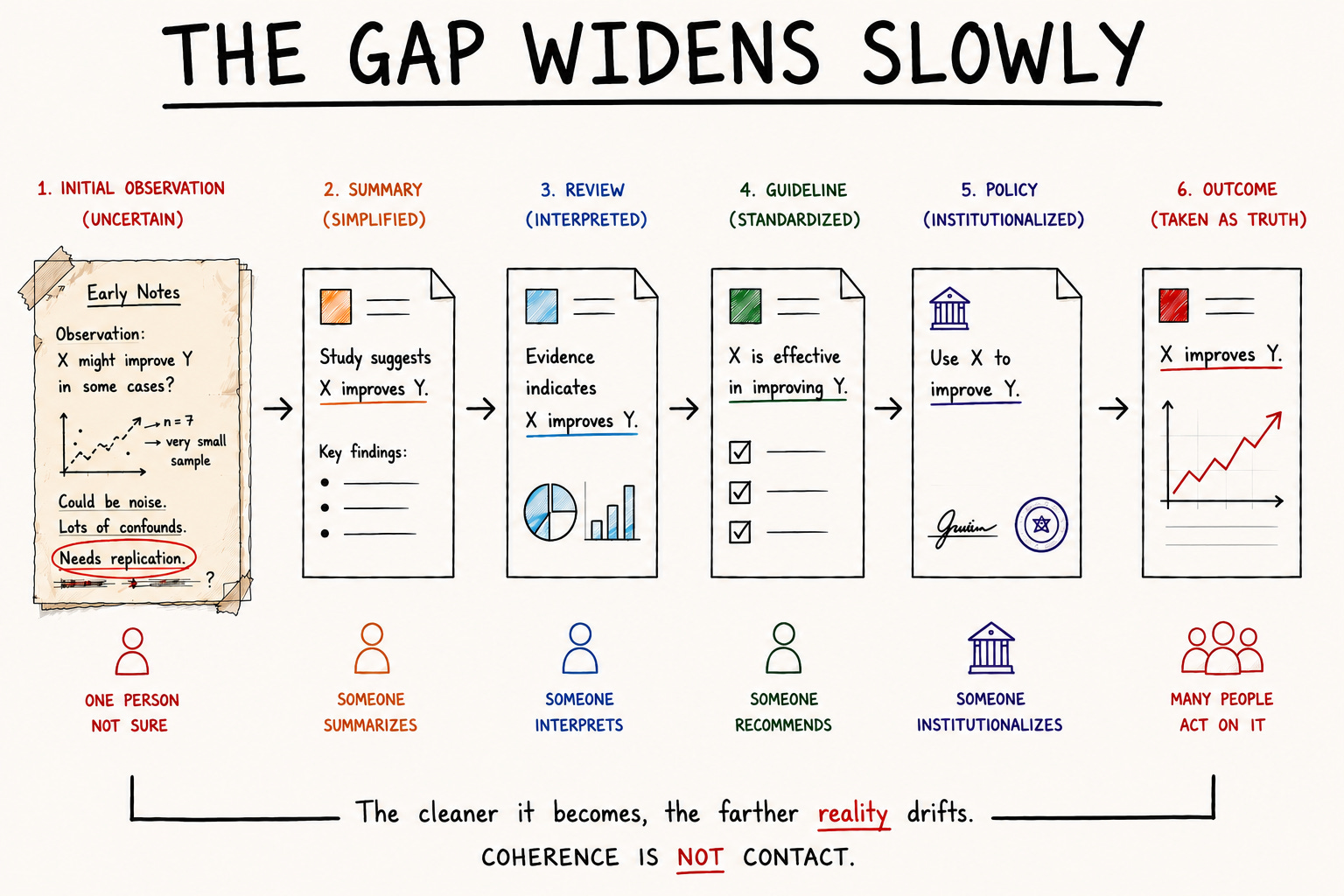
Semantic drift intensifies once language starts feeding back into itself. An experience is turned into a description, the description is summarized, and the summary is ranked, indexed, and distributed. From there, a journalist names the pattern, an organization adopts the terminology, and search systems begin rewarding the phrasing that is easiest to retrieve. At each stage, some structure is preserved, but the direct connection to lived reality becomes diluted at every step.
AI systems now enter this loop at high speed. They inherit not only human knowledge, but centuries of accumulated compression, with no intrinsic way to distinguish which parts are still anchored in perception and which have already drifted. Then AI-generated language reenters the environment, and becomes material for future training data and the next cycle of posts, articles, and content we see online. The language layer begins drawing from itself, and culture starts to feel like it is being generated from its own residue.
When Language Becomes the Environment
As more of life is mediated through information systems, language stops being something people simply use and becomes the environment they move through. We encounter representations before we encounter the things they describe. The direction of dependence flips and language begins shaping experience in advance. Once a representation settles in people’s minds, reality is often interpreted through that representation. Correction gets harder under these conditions. Reality can still push back, but it has to move through layers of expectation and framing that were there first.
Constraint collapse begins when reality can still create contradictions, but those contradictions no longer force the story to change. This is the failure mode hiding underneath much of modern life. Institutions, media systems, and AI systems all depend on language retaining enough fidelity to mean what it appears to mean. But when compression runs ahead of grounding, symbolic systems can remain functional while their representations lose contact with the world they were built to describe.
At first, very little looks wrong. The sentences remain well-formed, the dashboards stay green, and the explanations remain plausible. But coherence is not contact, and agreement is not truth. A society does not need its language to collapse to be misled by it. It only needs the language to keep making sense after it has stopped pointing back to reality.
Framework Resources
What Is Reality Drift?
A short introduction to the framework and why it matters.Reality Drift Overview & FAQ
A broader explanation of its structure, mechanisms, and applications.Reality Drift Glossary
Definitions of the framework’s core concepts and terminology.